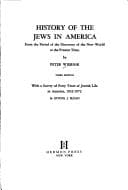
History of the Jews in America: From the Period of the Discovery of the New World to the Present TimeWiernik, Peter
History
History of the Jews in America: From the Period of the Discovery of the New World to the Present Time
Wiernik, Peter
Jews -- America -- History; Jews -- United States -- History
When a distinguished Roman Catholic, William Gaston (1778‒1844), was
chosen Justice of the Supreme Court of North Carolina (1834) a doubt
arose, even in his own mind, whether he could accept the office. But he
resorted to an even more ingenious interpretation of the Constitution,
which was subsequently followed in other cases as well. He argued that
the word “deny” implied an overt act, and that “the Constitution does
not prescribe the faith which entitles to or excludes from civil office,
but demands from all those who hold office, that decent respect of the
prevalent religion of the country which forbids them to impugn it, to
declare it false, to arraign it as an imposition upon the credulity of
the people.”
While the acceptance of this decision made it possible for every one
to hold office, the efforts to abolish the religious test altogether
did not cease. The question was again thoroughly debated at the
Convention which came together in 1835 to amend the State Constitution.
There were practically no Jews in the State even then, but some of
the distinguished members of the Convention championed the cause of
absolute religious liberty and worked for the abolition of the entire
article which prescribed the test. Their efforts, however, were not
successful, and the change which was adopted emancipated only the
Catholics, by substituting the word “Christian” for “Protestant.”
The small Jewish Congregation of Wilmington, N. C., which was organized
in 1852 for burial purposes, began about four years later to circulate
a petition for the removal of the existing disability. A bill to that
effect was introduced in the Legislature in the same year (1858),
but the committee to which it was referred reported that while it
considered the objectionable clause “a relic of bigotry and intolerance
unfit to be associated in our fundamental law with the enlightened
principle of representative government ... it is highly inexpedient
to alter or amend the Constitution by legislative enactment in any
particular whatsoever.”
Public-domain text, read in full here on John Shaqi.
Reviews
Reviews
No reviews yet
Be the first to share your thoughts on this work.
Elsewhere in the archive
Join the Discussion
Join the discussion
Sign in to leave a comment or review.
Sign InorCreate an account