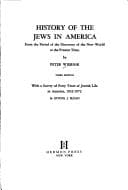
History of the Jews in America: From the Period of the Discovery of the New World to the Present TimeWiernik, Peter
History
History of the Jews in America: From the Period of the Discovery of the New World to the Present Time
Wiernik, Peter
Jews -- America -- History; Jews -- United States -- History
The number of Jews who took part in the War of 1812 was therefore
smaller than that of the participants in the War of Independence, and
the disproportionately large percentage of officers shows that they
still belonged mostly to the wealthier classes. In the list which is
enumerated in the valuable work of Mr. Simon Wolf, which was mentioned
above, there are mentioned thirteen officers, of whom one, Nathan Moses
of Pennsylvania, achieved the rank of Colonel, and two, Mayer Moses
of South Carolina and Mordecai Myers of Pennsylvania, were captains.
(General Joseph Bloomfield of New Jersey, who is included in the list,
was not a Jew, see “Publications,” XI. p. 190.) The balance comprises
three lieutenants, one adjutant, one ensign, two sergeants, three
corporals and twenty-seven privates. Among the latter were Jacob Hays,
and Benjamin Hays of New York, father and son; and Judah Touro, the
philanthropist, who was dangerously wounded at the battle of New
Orleans in January, 1815.
The War of 1812 gave the impetus to a renewal of the agitation for the
removal of the disabilities of the Jews of Maryland, the only State
which had a considerable Jewish community in such a disadvantageous
position. The church establishment in Maryland terminated with the
fall of the proprietary rule and the emergence into statehood. With
it fell, too, the force of the legislation which for a century and
a half had declared the profession of Jewish faith a capital offence,
as was already mentioned in a previous chapter (page 77).[25] But part
of the old spirit remained under the new conditions, and the new State
Constitution of 1776, which granted free exercise of religion, provided
for “a declaration of belief in the Christian religion” as a necessary
qualification for holding public office. But this did not prevent
a gradual influx of Jews during and after the Revolutionary War,
which is to be attributed to the commercial and industrial advantages
of Baltimore. The first formal effort to effect the removal of the
disability was made in December, 1797, when Solomon Etting (b. in York,
Pa., 1764; d. in Baltimore, 1847), Bernard Gratz (b. in York, Pa.,
1764; d. in Baltimore, 1801) and others presented a petition to the
General Assembly at Annapolis in which they averred “that they are
a sect of people called Jews, and thereby deprived of many of the
valuable rights of citizenship, and pray to be placed upon the same
footing with other good citizens.” The committee to whom this petition
was referred reported the same day that they “have taken the same into
consideration and conceive the prayer of the petition is reasonable,
but as it involves a constitutional question of considerable importance
they submit to the House the propriety of taking the same into
consideration at this advanced stage of the session.” This disposition
of the petition put a quietus upon further agitation for the next five
years. In the meantime (1801) Reuben Etting (b. in York, Pa., 1762; d.
Public-domain text, read in full here on John Shaqi.
Reviews
Reviews
No reviews yet
Be the first to share your thoughts on this work.
Elsewhere in the archive
Join the Discussion
Join the discussion
Sign in to leave a comment or review.
Sign InorCreate an account