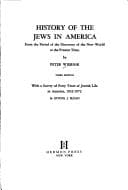
History of the Jews in America: From the Period of the Discovery of the New World to the Present TimeWiernik, Peter
History
History of the Jews in America: From the Period of the Discovery of the New World to the Present Time
Wiernik, Peter
Jews -- America -- History; Jews -- United States -- History
While the last vestiges of discrimination against the Jews were being
removed in Maryland, a grandiose plan for solving the Jewish problem
through colonization in America was conceived by one of the most
prominent Jews of New York. This man was Mordecai Manuel Noah (b. in
Philadelphia, July 19, 1785; d. in New York March 22, 1851). He was of
Portuguese descent, a son of Manuel Mordecai Noah of South Carolina,
who served in the Revolutionary army, and a cousin of Henry M. Phillips
(b. in Philadelphia, 1811; d. there 1884), who was a member from the
fourth district of Pennsylvania in the Thirty-fifth Congress (elected
as a Democrat in 1856), and besides occupying various positions of
honor and trust, also served as Grand Master of Free Masons of his
native State. Noah was left an orphan at the age of four, and was
brought up by his maternal grandfather, Jonas Phillips (b. in Germany,
1736; d. in Philadelphia, 1803). Noah was apprenticed to a carver and
gilder, but his studious habits and abilities attracted the attention
of some prominent men, and it is said that the financier, Robert Morris,
procured the cancellation of his indentures and obtained for him an
appointment as clerk in the office of the Auditor of the United States
Treasury.
Upon the removal of the national capital to Washington, young Noah
resigned his clerkship and accepted employment as a reporter at the
sessions of the Pennsylvania Legislature at Harrisburg, where he
acquired his first experience in journalism. Several years later he
removed to Charleston, S. C., where he became in 1809 the editor of
“The City Gazette” and became an ardent advocate of war with England.
This was against the prevailing spirit of the wealthy seaport town, and
it involved him in many quarrels and in several duels, in one of which
he killed his opponent. It was also in this city that his first play,
“Paul and Alexis,” or “The Orphans of the Rhine,” was performed for the
first time. It was afterwards taken to England, where it was somewhat
altered, and with its name changed to “The Wandering Boys” was brought
out in 1820 at the Park Theatre in New York with great success.
Public-domain text, read in full here on John Shaqi.
Reviews
Reviews
No reviews yet
Be the first to share your thoughts on this work.
Elsewhere in the archive
Join the Discussion
Join the discussion
Sign in to leave a comment or review.
Sign InorCreate an account