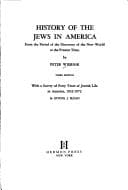
History of the Jews in America: From the Period of the Discovery of the New World to the Present TimeWiernik, Peter
History
History of the Jews in America: From the Period of the Discovery of the New World to the Present Time
Wiernik, Peter
Jews -- America -- History; Jews -- United States -- History
those of its devotees who emphasize its progressive side and neglect
the eternal and historical sides.
These conditions reduced the struggle between Orthodoxy and Reform to
something hardly above an animated controversy in the denominational
periodicals, and its historical value consists chiefly as an indicator
of material progress. There was no class-struggle between the wealthy
Jews and their poorer brethren who came after them in increasingly
larger numbers, and there was no real conflict between the former’s
and the latter’s religious views for the same reason. Accession to the
ranks of wealth usually meant affiliation with a Reform congregation,
where the poor man could not afford to join and would not be welcome if
he came. While several of the young enthusiasts who came over permeated
with the fighting spirit of the German reformers might have thought at
the beginning of continuing the struggle in the Old-World fashion until
the “enemy” was annihilated, it did not take them long to discover the
futility of such efforts. The task of Reform Judaism in America was
plainly not to conquer the Orthodox synagogue or to win recruits from
the ranks of those who wished to remain faithful to traditional Judaism,
but to enroll under its banner the affluent American or Americanized
Jews who were on the point of drifting away altogether. The view of
the extremely conservative, who considered these reformers as already
lost to Judaism, has been shared by a large majority of the Jews of
the United States for the last sixty or seventy years. But aside from
condemning public declarations which were offensive to the Orthodox
spirit and which were occasionally made by reformed bodies or by
their conspicuous representatives, the Orthodox masses have, as usual,
displayed more fortitude than aggressiveness in religious matters. This
accounts for the presence of numerous leaders, agitators and organizers
in the Reform camp, where newly assumed positions had to be defended
to one’s own satisfaction even if there was no formidable attack; while
Orthodoxy easily held its own by force of increasing numbers, even if
its tenacity was relaxed by the stress of circumstances.
Public-domain text, read in full here on John Shaqi.
Reviews
Reviews
No reviews yet
Be the first to share your thoughts on this work.
Elsewhere in the archive
Join the Discussion
Join the discussion
Sign in to leave a comment or review.
Sign InorCreate an account