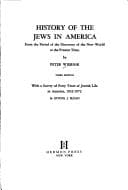
History of the Jews in America: From the Period of the Discovery of the New World to the Present TimeWiernik, Peter
History
History of the Jews in America: From the Period of the Discovery of the New World to the Present Time
Wiernik, Peter
Jews -- America -- History; Jews -- United States -- History
The Jews of the United States were also in open sympathy with the
liberal movements in Central Europe, especially in Germany, which
culminated in the revolutions of the year 1848. While there was
no active co-operation or direct assistance in those times of slow
communication, those who wrote from America described the conditions
prevailing here as well-nigh ideal from the liberal point of view. A
poem by Sigmund Herzl, entitled “Auf! Nach Amerika!” which appeared
in the “Central Organ,” published in Vienna in 1848 by Isidor Bush
(b. in Prague, Bohemia, 1822; a. in New York, 1849; d. in St. Louis,
Mo., 1898), in which America is described as a place where true
brotherly love reigns supreme, where ignorance and base prejudice
are entirely unknown, may be taken as an example of the expression of
that sentiment. When the great Jewish champion of the liberal movement
in Germany, Gabriel Riesser (b. in Hamburg, Germany, 1806; d. there
1863), visited America in 1856, he was greeted by many former German
revolutionary soldiers――both Jewish and Christian――and in New York they
gave a public dinner in his honor. German Jews in Philadelphia formed
a Riesser Club, which existed for a number of years. (See Albert M.
Friedenberg in “Publications,” XVII, pp. 204–5.)
* * * * *
The first diplomatic difficulties which the Government of the United
States experienced on account of discrimination against its Jewish
citizens occurred about this time, and――strangely enough――it was not
with Russia, but with the Swiss Confederation. A general convention
between the two republics was drawn and signed at Berne, November 25,
1850, by Mr. A. Dudley Mann, American Minister to Switzerland, on the
part of the United States, and by Messrs. Druey and Frey-Hérosée on
the part of the Swiss Confederation. This treaty and a copy of the
instructions under which Mr. Mann acted, together with his dispatch
of November 30, 1850, explanatory of the Articles of Convention,
were transmitted to the United States Senate on February 13, 1851, by
President Millard Fillmore (1800–74). Neither the treaty nor the papers
accompanying it were ever made public, the ban of secrecy imposed by
the Senate having never been removed. But President Fillmore himself,
in the message transmitting the treaty, objected to it in the form
in which it was presented. He said: “There is a decisive objection
arising from the last clause in the First Article. That clause is in
these words: _On account of the tenor of the Federal Constitution of
Switzerland, Christians alone are entitled to the enjoyment of the
privileges guaranteed by the present Article in the Swiss Cantons. But
said cantons are not prohibited from extending the same privileges to
citizens of the United States of other religious persuasions._
Public-domain text, read in full here on John Shaqi.
Reviews
Reviews
No reviews yet
Be the first to share your thoughts on this work.
Elsewhere in the archive
Join the Discussion
Join the discussion
Sign in to leave a comment or review.
Sign InorCreate an account