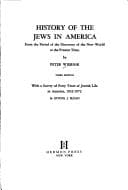
History of the Jews in America: From the Period of the Discovery of the New World to the Present TimeWiernik, Peter
History
History of the Jews in America: From the Period of the Discovery of the New World to the Present Time
Wiernik, Peter
Jews -- America -- History; Jews -- United States -- History
In the meantime, although it was asserted on behalf of Switzerland that
the discriminations which it insisted upon were only “a precautionary
measure ... a safeguard against the immense itinerant (Jewish)
population of Alsace,” the two Cantons of Basle vigorously executed a
decree of banishment against the Jews which was promulgated November
17, 1851. The law was suspended for a few months because of a note sent
by Emperor Napoleon III. to the Council of the Federation, in which he
said “That France will expel all Swiss citizens established in France
in case the two Cantons should insist on carrying out this law against
the Jews.” But while the negotiations were pending, the two Cantons
carried out the law of expulsion, and no further steps were taken
by France. About this time there was set on foot in this country a
movement to procure religious toleration abroad for American citizens
generally. It appears to have been aimed at the persecution of American
Protestants in Catholic countries, and the movement to secure redress
in this direction culminated in a resolution introduced in the House of
Representatives, December 13, 1852, by John A. Wilcox, of Mississippi,
which declared “that the representatives of this Government at foreign
courts be instructed to urge such amendments of all existing treaties
between the United States and the other powers of the world as will
secure the same liberty of religious worship to all American citizens
residing under foreign flags which is guaranteed to all citizens of
every nation of the whole world who reside under the flag of our Union.”
Objection was made to this resolution as an encroachment upon the
powers of the Executive, and action was delayed for a long time. A
resolution of a similar nature, which was reported to the Senate from
the Committee on Foreign Relations, February 17, 1853, met the same
fate. But all these discussions had the effect of the Senate refusing
to ratify the treaty with Switzerland in the form in which it was sent
to it. Mr. Mann thereupon proceeded to negotiate another treaty which,
while striking from it the clause objected to by the President and
the other notable men mentioned above, yet in another form inserted a
clause, the effect of which was the same as that of the clause which
had been stricken out. Article I of this new treaty read as follows:
The citizens of the United States of America and the citizens
of Switzerland shall be admitted and treated upon a footing of
reciprocal equality in the two countries, where such admission
and treatment shall not conflict with the constitutional or
legal provisions, as well Federal as State and Cantonal of the
contracting parties.
Public-domain text, read in full here on John Shaqi.
Reviews
Reviews
No reviews yet
Be the first to share your thoughts on this work.
Elsewhere in the archive
Join the Discussion
Join the discussion
Sign in to leave a comment or review.
Sign InorCreate an account