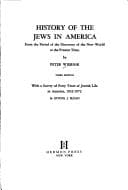
History of the Jews in America: From the Period of the Discovery of the New World to the Present TimeWiernik, Peter
History
History of the Jews in America: From the Period of the Discovery of the New World to the Present Time
Wiernik, Peter
Jews -- America -- History; Jews -- United States -- History
But while Germans formed a large part of those who arrived in the
two or three decades after the war, the number of Jews who left that
country was now very small, and sank to almost nothing about 1880.
What was described by a Jewish traveler[41] as the second German-Jewish
migration to America, which began about 1836, and to which “Bavaria
contributed the largest quota of (Jewish) immigrants, because of
her peculiarly harsh (anti-Jewish) marriage laws and commercial
restrictions,” practically ended in the decade of the Civil War,
when the Jews were emancipated in most of the German states. The
progress made by these immigrants in less than one generation can be
best illustrated by quoting two passages from the same article by Mr.
Kohler: “The early German settlers commonly arrived here without means,
frequently without any education other than of the most rudimentary
character.” Subsequently (p. 102) he quotes a German-American
politician, who wrote in 1869: “The German Jews in America gain
in influence daily, being rich, intelligent and educated, or at
least seeking education. They read better books than the rest of the
Germans....”
This progress was largely accelerated by the great business activity
which followed the war. A large number of the German-Jewish immigrants
amassed wealth, and the stoppage of the arrival of new poor immigrants,
or rather of poor relatives, reduced the number of the needy and
helpless among them to an insignificant fraction. It may be said that
it was during these fifteen years (1865–80), between the preceding
large German-Jewish immigration and the following incomparably larger
Russian-Jewish influx, that the Jews of the United States succeeded
in bringing their communal house to order, and in preparing for
their historic mission of receiving the great masses which were soon
to be driven thither from the Slavic countries by the iron hand of
persecution. Most of the large charitable institutions, which are the
pride of American Judaism, and have served to relieve want and pain in
various forms, actually date from that period. The date of organization
or original foundation is in most cases much earlier. But at the
beginning these institutions were more like the small charities which
are now founded by poor immigrants. There were very few great Jewish
institutions in the United States prior to the Civil War, although most
of the magnificent organizations in the older communities justly claim
a continued existence from ante-bellum days. The largest number and the
most important of them grew to their imposing size and vast usefulness
in “the seventies,” i. e., in that breathing spell which the Jews of
America had between two periods of immigration.
Public-domain text, read in full here on John Shaqi.
Reviews
Reviews
No reviews yet
Be the first to share your thoughts on this work.
Elsewhere in the archive
Join the Discussion
Join the discussion
Sign in to leave a comment or review.
Sign InorCreate an account