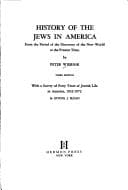
History of the Jews in America: From the Period of the Discovery of the New World to the Present TimeWiernik, Peter
History
History of the Jews in America: From the Period of the Discovery of the New World to the Present Time
Wiernik, Peter
Jews -- America -- History; Jews -- United States -- History
small shops, where they employed those who came after them. While wages
were comparatively small and “sweating” was common, the earnings were
so much above what the poor man can make in Russia, and the standard of
living so much higher than the one to which the laborer is accustomed
over there, that even those who worked under what an American would
consider the worst circumstances, soon saved enough money to begin
sending for their families, their relatives, and even their friends.
The great mass was solving its own problem by hard work and by thrift;
it built up and multiplied the industries in which it was occupied, and
thus made it easy to absorb the newcomers year by year and to become
a part of the great industrial army which is doing the work of the
country.
Thus there arose a third and new class of Jewish immigrants, unlike
the first or Sephardic small groups who came here usually with large
means and took their position among the higher classes as soon as they
arrived; also unlike the second and larger groups of German, Polish
and Hungarian Jews who came in the second period, most of whom began as
peddlers and artizans, but ultimately became merchants or professional
men. Among the immigrants of the third period, which began in 1881,
there were many men of means and skilled men who at once joined the
better situated classes. There were also among them a large number
who took up peddling or petty trade with various degrees of success.
But the agriculturists and the industrial workers, or proletariat,
are distinctive features of the new period. The colonist was mostly
assisted and usually failed; then he joined the trading or the working
classes in the cities. The industrial classes took care of themselves
and fared much better. Even their new problems presented difficulties
which were more apparent than real. The seeming persistence in errors
which are characteristic of those who are here only a short time is
easily explained when it is considered that in cities like Philadelphia
or Chicago there are always thousands, and in New York there are always
tens of thousands, of Jewish immigrants from Slavic countries who came
to this country within the last year. So there is always at hand a
mass which is not aware of what a similar mass――which to the outsider
seems the same――did a year before; and what seem to be repetitions year
after year of the same actions which lead to the same results or to the
same lack of results, are actually experiments made but once by each
successive wave of immigration and soon abandoned, only to be taken up
later as a novel experience by those who come later.
Public-domain text, read in full here on John Shaqi.
Reviews
Reviews
No reviews yet
Be the first to share your thoughts on this work.
Elsewhere in the archive
Join the Discussion
Join the discussion
Sign in to leave a comment or review.
Sign InorCreate an account