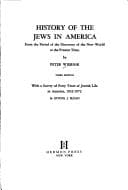
History of the Jews in America: From the Period of the Discovery of the New World to the Present TimeWiernik, Peter
History
History of the Jews in America: From the Period of the Discovery of the New World to the Present Time
Wiernik, Peter
Jews -- America -- History; Jews -- United States -- History
In less than a decade after the first influx from Russia, an attempt
was made to establish some form of co-operation between the immigrants
of the new period and the American or Americanized Jews who belonged
to the former periods. The latter were complaining that the burden of
charities was becoming too heavy, while from the former, especially
from the more intelligent immigrants who were interested in Jewish
matters, there arose even at that early date a demand for recognition
and a share of responsibility in communal work. The theory that the two
elements, described respectively as the German and the Russian, must be
brought nearer together, and that the latter element must be prepared
to take over the hegemony of the Jewish community from the former,
just as the German took it over from the Sephardim, was already then,
as it is to some extent still now, a favorite with those who consider
themselves representatives of the immigrants. And it was the effort to
apply part of this theory to practice, and perhaps, according to some,
to put it to the test, that a call was issued for a convention of the
Jewish Alliance of America, which met in Philadelphia on February 15,
1891.
Nineteen cities were represented, some of them as far as San Francisco,
Cal. (by Bernhard Marks), and Portland, Ore. (David Solis-Cohen).
Boston was represented by David Blaustein (b. in Lida, Russia, 1866; a.
1886), who later became eminent as an educator and communal worker. The
Hon. Simon Wolf (b. in Rhenish Bavaria, 1836; a. 1848), a recognized
representative in Washington of the Jews of the country, came from the
capital. There were twenty delegates from Baltimore, including Samuel
Dorf and B. H. Hartogensis. Chicago sent six men, including Dr. A. P.
Kadison and Leon Zolotkoff (b. in Wilna, 1865(?); a. 1887). Among the
seven delegates from New York were the Russian immigrants Nicholas
Aleinikoff and P. Caplan, and the native American, Ferdinand Levy (b.
in Milwaukee, Wis., 1843), who served in the Union army with his father
and two brothers during the Civil War, and held various offices in New
York City and in Jewish fraternal organizations. The largest contingent
was, of course, from Philadelphia, its fifty-four delegates including
many well-known men from both elements, like the inventor, Louis E.
Levy (b. in Bohemia, 1846), Dr. Solomon Solis-Cohen, a native of
Philadelphia; Bernhard Harris, who was chosen secretary, and Dr.
Charles D. Spivak (b. in Krementshug, Russia, 1861; a. 1882), who was
president of the temporary organization.
Public-domain text, read in full here on John Shaqi.
Reviews
Reviews
No reviews yet
Be the first to share your thoughts on this work.
Elsewhere in the archive
Join the Discussion
Join the discussion
Sign in to leave a comment or review.
Sign InorCreate an account