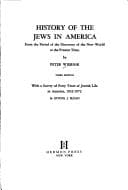
History of the Jews in America: From the Period of the Discovery of the New World to the Present TimeWiernik, Peter
History
History of the Jews in America: From the Period of the Discovery of the New World to the Present Time
Wiernik, Peter
Jews -- America -- History; Jews -- United States -- History
The Jews of America were thus even better prepared to receive a large
number of Jewish immigrants at the beginning of the last decade of the
nineteenth century than they were ten years before. There was also at
this time a smaller number and a much smaller proportion of helpless
people among the Russian refugees, for those who lived in the interior
of Russia, outside of the “pale of settlement”, and would have remained
there had it not been for the expulsions, were as a rule active and
fairly successful men, and therefore better able to take care of
themselves than those whom poverty or lack of employment forced to
emigrate. Many more found relatives and friends here than in 1881–82,
and among those who were here there were also many more who could be
of assistance to new arrivals than in former times. As a matter of
fact, Jewish immigration from the Slavic countries had then assumed
its natural form, which it has retained ever since, except in the
years following the massacres in the present century. Most men come to
kinsmen or personal friends, who are willing and able to assist them in
finding their way. A large majority consists of wives and children, of
parents and other near relatives, who come because they were sent for
and because the breadwinner or the most energetic member of the family
has previously established himself here and demands their ♦presence,
or feels certain that they will soon be able to provide for themselves.
The helpless Jewish immigrant who has nowhere to go and nothing to do
when he arrives, is now very rare, and has been rare for the last two
decades.
The number of the new immigrants needing assistance immediately after
their arrival had been reduced to such a small fraction that those
having the interest of the Jewish masses at heart began to express
their opinion that it would perhaps be better if organized charity
would leave them alone altogether. At first this opinion was uttered
mostly in the Yiddish press or at meetings of immigrants. But in
time there came not only a still further improvement in the general
condition of the Jews, and also a further diminution in the number
of helpless immigrants, but the voice of the immigrant-citizen became
more potent in communal affairs. The folly of appeals, in which the
wants of that class were exaggerated, became apparent; a large number
of the employees of charitable institutions, and even some of the
directors, were now Russian or Galician or Roumanian Jews, with a
closer acquaintance with the needs, and also with the lack of needs,
of the new arrivals. Much of the friction due to the resentment against
help, which was rendered sometimes with more ostentation than the
circumstances required, was obviated under the altered conditions, and
the ground was prepared for a new co-operation of all elements of the
community.
Public-domain text, read in full here on John Shaqi.
Reviews
Reviews
No reviews yet
Be the first to share your thoughts on this work.
Elsewhere in the archive
Join the Discussion
Join the discussion
Sign in to leave a comment or review.
Sign InorCreate an account