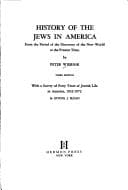
History of the Jews in America: From the Period of the Discovery of the New World to the Present TimeWiernik, Peter
History
History of the Jews in America: From the Period of the Discovery of the New World to the Present Time
Wiernik, Peter
Jews -- America -- History; Jews -- United States -- History
The writers of Hebrew, who by reason of their training and inclination
held more aloof even from their own public, have not yet solved the
great question of style; which partly accounts for the remarkable
fact that their periodical literature has actually vanished in the two
decades in which the possible number of their readers has increased
almost tenfold. Some of the best known Hebrew literati from the Old
World came here since the establishment of the Neo-Hebrew periodicals
which were mentioned above: men like the poet Menahem Mendel Dolitzki
(b. in Byelostok, 1856; a. 1892); the exegete Abraham Baer Dobsevage
(b. in Pinsk, 1843; a. 1891; d. in New York, 1900); the philosopher
Joseph Loeb ♦Sossnitz (b. in Birz, 1837; a. 1891; d. in New York,
1910); the grammarian Moses Reicherson (b. in Wilna, 1827; a. 1890;
d. in New York, 1903), and the knight-errant of Hebrew literature,
Naphtali Hirz Imber (b. in Zloczow, Galicia, 1856; a. 1892(?); d. in
New York, 1909). But neither they nor others less known, who could
perhaps be more productive under more favorable circumstances, could
accomplish much even in those branches of literary journalism where
Yiddish has not penetrated. They were not entirely idle, and some
of the results of their literary labor will be mentioned in the
proper place in a following part of this work. But they have not
influenced the Jewish spirit and have contributed little to the general
intellectual development of the community. The traditional war for
progress which they waged in their old homes, where they were often
the only learned or enlightened men in the community, had no place in
a world where general education is so easily accessible; and they could
not feel at home in the ranks of the conservatives, where they belong
in this country. Most of them floundered until the rise of the Zionist
movement, which they joined half-heartedly. Many took to teaching of
Hebrew, and are still waiting for the expected revival of interest in
Hebrew literature which the new nationalism is supposed to produce.
CHAPTER XXXIII.
RELATIONS WITH RUSSIA. THE PASSPORT QUESTION.
The normal rate of Jewish immigration is but slightly affected by
the panic of 1893――Oppressiveness of the Sunday Laws are felt
by the new immigrants――The Extradition Treaty with Russia――
Beginning of the struggle about the Passport Question――The
first Resolution against Russia’s discrimination, introduced
in Congress by Mr. Cox in 1879――Diplomacy and diplomatic
correspondence――More resolutions――Rayner, Fitzgerald, Perkins――
Henry M. Goldfogle――John Hay’s letter to the House――More
letters, speeches and discussions――The Sulzer Resolution and
the last step to abrogate the Treaty of 1832.
Public-domain text, read in full here on John Shaqi.
Reviews
Reviews
No reviews yet
Be the first to share your thoughts on this work.
Elsewhere in the archive
Join the Discussion
Join the discussion
Sign in to leave a comment or review.
Sign InorCreate an account