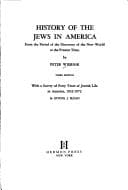
History of the Jews in America: From the Period of the Discovery of the New World to the Present TimeWiernik, Peter
History
History of the Jews in America: From the Period of the Discovery of the New World to the Present Time
Wiernik, Peter
Jews -- America -- History; Jews -- United States -- History
_Resolved_, By the Senate and the House of Representatives of
the United States of America in Congress Assembled, that the
rights of the citizens of the United States should not be
impaired at home or abroad because of religious belief; and
that if existing treaties between the United States and Russia
be found, as is alleged, to discriminate in this or any other
particular, as to any other classes of our citizens, the
President is requested to take immediate action, to have the
treaties so amended as to remedy this grievance.
After a debate, in which the fact that English Jews were permitted to
own land in Russia, was brought out, this Resolution passed the House
of Representatives June 10, 1879, and as far as known was not heard of
again.
In the diplomatic correspondence which followed, the American
Government insisted on its rights under the treaty and urged its
minister to claim absolutely equal treatment for all American citizens
alike, Jews as well as others. The arguments and the mode of procedure
which are now familiar to every one who is interested in the question,
were all used thirty years ago, though the only effective remedy,
suggested by the first resolution, “to take immediate steps to have
the treaties amended,” had not been resorted to. But the question of
former Russian subjects who return to Russia as American citizens,
in which the principle of expatriation and right of naturalization is
involved, is not touched upon in these early disputes. There is even
a clear intimation that the Russian Government’s chief objection was
against naturalized Jews from Germany. Mr. Foster, who was then our
representative in St. Petersburg, in a dispatch dated December 30,
1880, reports an interview which he had with M. de Giers, the Russian
Minister of Foreign Affairs, and says:
So far as concerned Jews who are bona fide American citizens
(not disguised German Jews), he would assure me of the most
liberal treatment, as he knew it was the desire of the Emperor
to show all possible consideration to American citizens. If such
came to St. Petersburg and encountered any trouble, if I would
merely send him an unofficial note, he would give them all the
time I might ask for them to remain here to attend to their
business....
The same dispatch reports also a conversation with the Minister of
Worship, who “listened with much interest to my presentation of the
subject. He said that a commission was now engaged in studying the
question of reform in these laws,” and “frankly recognized that the
laws were not fully in accordance with the spirit of the age.” But in
the end of this document Mr. Foster acknowledges his failure to obtain
what he wanted and says that “the Russian Government was disposed to
grant what we desired only as a favor when my government asked it as
a right” (quoting Loris Melikov).
Public-domain text, read in full here on John Shaqi.
Reviews
Reviews
No reviews yet
Be the first to share your thoughts on this work.
Elsewhere in the archive
Join the Discussion
Join the discussion
Sign in to leave a comment or review.
Sign InorCreate an account