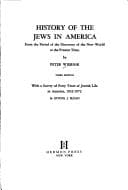
History of the Jews in America: From the Period of the Discovery of the New World to the Present TimeWiernik, Peter
History
History of the Jews in America: From the Period of the Discovery of the New World to the Present Time
Wiernik, Peter
Jews -- America -- History; Jews -- United States -- History
The agitation of the subject in Congress continued, however, and
finally both houses adopted a bill for an educational test, excluding
persons physically capable and over sixteen years of age who could not
read and write the English language or some other language, parents,
grandparents, wives and minor children of admissible immigrants being
excepted. President Grover Cleveland (1837–1908) returned the bill with
his veto on March 2, 1897. He objected to the radical departure from
the previous national policy relating to immigration, which welcomed
all who came, the success of which policy was attested by the last
century’s great growth. In referring to the claim that the quality
of recent immigration was undesirable, he said: “The time is quite
within recent memory when the same thing was said of immigrants who,
with their descendants, are now numbered among our best citizens.”
In referring to “the best reason that could be given for this radical
restriction,” the “protecting of our population against degeneration
and saving our national peace and quiet from imported turbulence and
disorder,” President Cleveland said that he did not think that the
nation would be protected against these evils by limiting immigration
to those who could read and write, for, in his mind, it was safer “to
admit a hundred thousand immigrants, who, though unable to read and
write, seek among us only a home and an opportunity to work, than to
admit one of those unruly agitators who can not only read and write,
but delight in arousing by inflammatory speech the illiterate and
peacefully inclined to discontent.” Those classes which we ought
to exclude, he claimed, should be legislated against directly. Some
sections of the bill against aliens who come regularly into the United
States from neighboring countries for the purpose of obtaining work, he
declared to be “illiberal, narrow and un-American.”
On March 3, 1897, the House passed the bill over the President’s veto
by a vote of 193 to 37, but no action was taken in the Senate, and the
veto was thus sustained. The same bill was introduced in the following
Congress (fifty-fifth) and passed by the Senate, but the House, by a
vote of 103 to 101 refused to consider it.
Public-domain text, read in full here on John Shaqi.
Reviews
Reviews
No reviews yet
Be the first to share your thoughts on this work.
Elsewhere in the archive
Join the Discussion
Join the discussion
Sign in to leave a comment or review.
Sign InorCreate an account