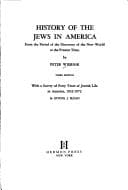
History of the Jews in America: From the Period of the Discovery of the New World to the Present TimeWiernik, Peter
History
History of the Jews in America: From the Period of the Discovery of the New World to the Present Time
Wiernik, Peter
Jews -- America -- History; Jews -- United States -- History
Within a week after the Brussels Conference (February 3–4), a
conference was held in New York City “to consider the formation of a
General Jewish Committee or other representative body of the Jews in
the United States.”[57] A committee which was appointed by the chairman,
Judge Mayer Sulzberger of Philadelphia, submitted its report to the
conference at a subsequent meeting (May 19), which was referred to a
Committee of Five, with instructions to select another Committee of
Fifteen, representative of all Jewish societies of the United States,
to be increased to fifty members, if considered desirable. About
a month later, the chairman announced the following Committee as
the nucleus of the American Jewish Committee, which was ultimately
increased to sixty: Cyrus Adler, Washington, D. C.; Nathan Bijur,
New York; Joseph H. Cohen, New York; Emil G. Hirsch, Chicago, Ill.;
D. H. Lieberman, New York; Julian W. Mack, Chicago, Ill.; J. L. Magnes,
New York; Louis Marshall, New York; Isidor Newman, New Orleans, La.;
Simon W. Rosendale, Albany, N. Y.; Max Senior, Cincinnati, O.; Jacob H.
Schiff, New York; Oscar S. Straus, New York; M. C. Sloss, San Francisco,
Cal., and Simon Wolf, Washington, D. C.
The American-Jewish Committee was organized with sixty members, and
adopted a constitution (November 11, 1906), which begins: “The purpose
of this committee is to prevent infringement of the civil and religious
rights of the Jews, and to alleviate the consequences of persecution.
In the event of a threatened or actual denial or invasion of such
rights, or when conditions calling for relief from calamities affecting
Jews exist anywhere, correspondence may be entered into with those
familiar with the situation, and if the persons on the spot feel
themselves able to cope with the situation, no action need be taken;
if, on the other hand, they request aid, steps shall be taken to
furnish it.” The Committee was later again increased on account of
the enlargement of the representation from New York City, owing to
the organization of the “Kehillah,” and last year consisted of the
following, representing the thirteen districts into which the country
was divided for that purpose:
Dist. I: Florida, Georgia, North Carolina, South Carolina, 2 members:
Ceasar Cone, Greensboro, N. C.; Montague Triest, Charleston, S. C.
Dist. II: Alabama, Mississippi, Tennessee, 2 members: Jacques Loeb,
Montgomery, Ala.; Nathan Cohn, Nashville, Tenn.
Dist. III: Arizona, Louisiana, New Mexico, Texas, 2 members: Maurice
Stern, New Orleans, La.; Isaac H. Kempner, Galveston, Tex.
Dist. IV: Arkansas, Colorado, Kansas, Missouri, 3 members: Morris M.
Cohen, Little Rock, Ark.; David S. Lehman, Denver, Col.; Elias Michael,
St. Louis, Mo.
Dist. V: California, Idaho, Nevada, Oregon, Utah, Washington, 3 members:
Max C. Sloss, San Francisco, Cal.; Harris Weinstock, Sacramento, Cal.;
Ben. Selling, Portland, Ore.
Public-domain text, read in full here on John Shaqi.
Reviews
Reviews
No reviews yet
Be the first to share your thoughts on this work.
Elsewhere in the archive
Join the Discussion
Join the discussion
Sign in to leave a comment or review.
Sign InorCreate an account