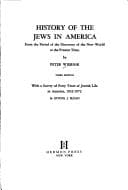
History of the Jews in America: From the Period of the Discovery of the New World to the Present TimeWiernik, Peter
History
History of the Jews in America: From the Period of the Discovery of the New World to the Present Time
Wiernik, Peter
Jews -- America -- History; Jews -- United States -- History
There are large Talmud Torahs in every city where there is a
considerable Jewish population, and, as in many other respects, New
York conditions are duplicated in Chicago, Philadelphia and other great
centers. In the smaller towns a Talmud Torah is now established soon
after the foundation of a synagogue, and the private teacher, who is
often also the Shochet and Chazzan or Mohel, usually antedates them
both. There is one important difference, however, between the Talmud
Torah of the Old World, especially Russia, and the same institutions
here. There the Talmud Torah is mainly for the children of the very
poor, for destitute orphans, foundlings and the like. Here the scarcity
of good private teachers, the high compensation which they require,
and the limited time which could be given to Jewish studies, makes
the organized school preferable also for the children of parents who
are willing and able to pay for tuition. Some Talmud Torahs which are
maintained by single synagogues for their members, especially in small
communities, partake of the nature, and even of the exclusiveness, of
the Sabbath School which is an adjunct to almost every well conducted
Reform Temple. _Volks-Schulen_, or Hebrew schools for girls, have
lately been established in several sections of New York, and also in
other cities.
There are also in every large community and in some sections of large
cities educational institutions whose chief object is to facilitate
the Americanization of the immigrants. The model institution of that
sort is the Educational Alliance (formerly the Hebrew Institute) of
New York. Some of them bear the name Educational Society, and a large
number, among which the Chicago institution, of which Julius Rosenwald
(b. in Springfield, Ill., 1862) is the chief patron, prefer the
old name of Hebrew Institute. This class of institutions have been
undergoing material changes for the last ten or fifteen years, and
those founded lately are entirely unlike those which belonged to
the earlier period. All fear that the newcomers will not become
Americanized sufficiently fast has now disappeared; and, besides, the
work of Americanization which was formerly done by private charity,
like the maintenance of evening classes and even of day classes for
adult immigrants, to instruct them in English and elementary knowledge,
is now done by the cities themselves. Private efforts are now made more
in the direction of Jewish education and religious or semi-religious
activities, and some of the Hebrew Institutes, notably the youngest and
those established and maintained by immigrants themselves, are almost
Talmud Torahs, often combined with synagogues, in which the religious
element predominates, and in some of them rabbis occupy the leading
positions.
Public-domain text, read in full here on John Shaqi.
Reviews
Reviews
No reviews yet
Be the first to share your thoughts on this work.
Elsewhere in the archive
Join the Discussion
Join the discussion
Sign in to leave a comment or review.
Sign InorCreate an account