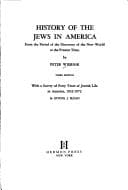
History of the Jews in America: From the Period of the Discovery of the New World to the Present TimeWiernik, Peter
History
History of the Jews in America: From the Period of the Discovery of the New World to the Present Time
Wiernik, Peter
Jews -- America -- History; Jews -- United States -- History
In the world of science many Jews have attained eminence as original
investigators and as university professors. Professor Albert Abraham
Michelson (b. in Strelno, Germany, 1852) was brought as a child to
San Francisco, and was from there appointed to the U. S. Naval Academy
at Annapolis, Md., graduating in 1873. He was an instructor in physics
and chemistry at the Naval Academy in 1875–9, and was in the office
of the Nautical Almanac in Washington until 1880, when he resigned
from the United States Navy. After spending several years studying in
Germany and France he became professor of physics at the Case School
of Applied Science in Cleveland, O. (1883–9). For the following three
years he occupied a similar position at Clark University, in Worcester,
Mass. Since 1892 he has been professor and head of the department of
physics in the University of Chicago. He is a member of various learned
societies here and abroad, including a corresponding membership in the
Academy des Sciences of the Institute de France. He won numerous prizes
and medals for his great scientific achievements, some of which, like
the Copley Medal, awarded by the Royal Society of London, and the Nobel
Prize for physics (both in 1907), indicate that he is recognized as
one of the greatest scientists of the age. He is best known as the
discoverer of a new method for determining the velocity of light. His
younger brother, Charles Michelson (b. in Virginia City, Nev., 1869),
editor of the “Chicago American,” and their sister, Miss Miriam (b.
in Calaveras, Cal., 1870), is a dramatic critic and has also written
numerous short stories and several novels.
Maurice Bloomfield (b. in Bielitz, Austria, 1855), who was brought here
at the age of twelve, is a prominent Sanskrit scholar and is recognized
as the chief living authority on the Atharva Veda. He has written
several important works on his special subjects, and has been professor
of Sanskrit and Comparative philology at Johns Hopkins University
in Baltimore, Md., since 1881. Jacob H. Hollander (b. in Baltimore,
1871), who was appointed by President McKinley special commissioner
to Porto Rico and later treasurer of that island colony, is professor
of political ♦economy at the same university. Professor Hollander
was appointed by President Roosevelt United States special agent on
taxation in Indian Territory (1904), and was in the following year sent
as special commissioner to the Republic of San Domingo to investigate
its public debt, and was the confidential agent of the Department of
State with respect to Dominican affairs. Since 1908 he has been the
financial adviser of the Dominican Republic. Professor Hollander takes
an active interest in Jewish affairs, and has contributed valuable
papers on Jewish history to the publications of the American-Jewish
Historical Society, of which he is an officer.
Public-domain text, read in full here on John Shaqi.
Reviews
Reviews
No reviews yet
Be the first to share your thoughts on this work.
Elsewhere in the archive
Join the Discussion
Join the discussion
Sign in to leave a comment or review.
Sign InorCreate an account