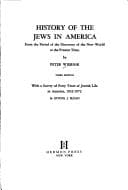
History of the Jews in America: From the Period of the Discovery of the New World to the Present TimeWiernik, Peter
History
History of the Jews in America: From the Period of the Discovery of the New World to the Present Time
Wiernik, Peter
Jews -- America -- History; Jews -- United States -- History
The Jews of New Amsterdam who had difficulties with Peter Stuyvesant
in 1655 about their right to trade on the South River, which was
subsequently re-named the Delaware (see above, chapter 9) were probably
the first to set foot in what later became the colony and still later
the State of Pennsylvania. This was twenty years before William Penn
(1644–1718) became part proprietor of West Jersey, and more than a
quarter of a century before he came over to America (1682) and founded
the city of Philadelphia in the colony of Pennsylvania, which he
received as a grant from the King of England in the preceding year.
The first Jewish resident of Philadelphia was Jonas Aaron, who was
living there in 1703. A number of other Jews settled there in the first
half of the eighteenth century and some of them, including David Franks
(1720–93), Joseph Marks and Sampson Levy, became prominent in the life
of the city. Isaac Miranda came there earlier (1710) and held several
State offices, but he was a convert to Christianity, and his preferment
cannot be considered a Jewish success. A German traveler mentions
the Jews among the religious sects of Philadelphia in 1734. In 1738
Nathan Levy (1704–53) applied for a plot of ground to be used as a
place of burial, and obtained it Sept. 25, 1740. This was the first
Jewish cemetery in the city, and was henceforth known as the “Jews’
burying ground,” situated in Spruce street, near Ninth street. It
later became the property of the Congregation Mickweh Israel, which
had its beginnings about 1745 and is believed to have worshipped in
a small house in Sterling alley. The question of building a Synagogue
was raised in 1761, as a result of the influx of Jews from Spain and
the West Indies, but nothing was then accomplished in that direction.
In 1773, when Barnard Gratz (born in Germany, 1738; died in Baltimore,
1801) was parnas and Solomon Marache, treasurer, a subscription was
started “in order to support our holy worship and establish it on a
more solid foundation,” but no Synagogue was built until about ten
years later. Barnard Gratz and his brother, Michael (b. 1740), with
whom he came to ♦America about 1755, were among the eight Jewish
merchants of Philadelphia who signed the Non-Importation Resolution in
1765. The others were Benjamin Levy, David Franks, Sampson Levy, Hyman
Levy, Jr.; Mathias Bush and Moses Mordecai.
Public-domain text, read in full here on John Shaqi.
Reviews
Reviews
No reviews yet
Be the first to share your thoughts on this work.
Join the Discussion
Join the discussion
Sign in to leave a comment or review.
Sign InorCreate an account