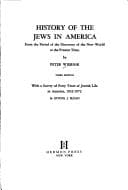
History of the Jews in America: From the Period of the Discovery of the New World to the Present TimeWiernik, Peter
History
History of the Jews in America: From the Period of the Discovery of the New World to the Present Time
Wiernik, Peter
Jews -- America -- History; Jews -- United States -- History
Jews were to be found in Lancaster, Pa., as early as 1730, before
the town and county were organized, and the name of Joseph Simon was
preserved as the best known of the first arrivals. Myer Hart (d. about
1795) and his wife, Rachel, and their son, Michael (b. 1738), were one
of the eleven original families that are classed as the founders of
Easton, Pa., about 1750. Myer Hart heads the list of those furnishing
material for the erection of a schoolhouse in Easton in 1755. He is
first described as a shopkeeper and later as an innkeeper, and he was
naturalized April 3, 1764. In 1780 his estate was valued at £2,095, and
that of his son, Michael, at £2,261, these two being the heaviest taxed
individuals in the county. At that period there were two other Jewish
merchants residing at Easton, Barnard Levi and Joseph Nathan.
There is a tradition that Schafferstown, Pa., had a Synagogue and a
Jewish cemetery in 1732, but the facts have not been verified, and
there is a suspicion that the supposed Jews were German pietists who
assumed Biblical names.
To the south of Pennsylvania the older colony of Maryland, which was
established in 1634, “adopted religious freedom as the basis of the
State;” but this boon was reserved for Christians only, although there
is no record that the statutory death penalty for those who denied
the trinity was ever carried out in practice. The physician, Jacob
Lumbrozo (d. May, 1666), who hailed from Lisbon, Portugal, and came to
Maryland about January, 1656, and later became an extensive land owner,
was committed for blasphemy in 1658, but this did not prevent him
from enjoying a lucrative practice and engaging in various mercantile
pursuits in subsequent years. He was even granted letters of denization
on Sept. 10, 1663, which vested him with all the privileges of a native
or naturalized subject. But his case seems to have been exceptional,
probably owing to his medical skill and his wealth. But in general,
colonial Maryland was no place for Jews, and even after it became a
part of the United States it was one of the last to remove the civil
disabilities of its Jewish citizens.
Public-domain text, read in full here on John Shaqi.
Reviews
Reviews
No reviews yet
Be the first to share your thoughts on this work.
Join the Discussion
Join the discussion
Sign in to leave a comment or review.
Sign InorCreate an account