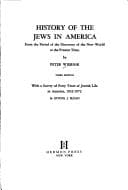
History of the Jews in America: From the Period of the Discovery of the New World to the Present TimeWiernik, Peter
History
History of the Jews in America: From the Period of the Discovery of the New World to the Present Time
Wiernik, Peter
Jews -- America -- History; Jews -- United States -- History
“Jews, heathens and dissenters” were granted full liberty of conscience
in the liberal charter which the celebrated English philosopher, John
Locke (1632–1704) drew up for the governance of the Carolinas (1669),
and the spirit of tolerance was always retained there. Still few Jews
were attracted there at the beginning, and about thirty years later
we know of only one Jew, Solomon Valentine, as living in Charleston. A
few others followed him, and in 1703 a protest was raised against “Jew
strangers” voting for members of the Assembly. About the middle of the
eighteenth century the number of Jews in Charleston suddenly increased
through the above-mentioned exodus from Georgia, and the first
Synagogue of the Congregation Bet Elohim was established in 1750. Its
first minister was Isaac da Costa, and among its earliest members were
Joseph and Michael Tobias, Moses Cohen, Abraham da Costa, Moses Pimenta,
David de Olivera, Mordecai Sheftal, Michael Lazarus and Abraham Nuñez
Cardozo. The first Synagogue was a small building on Union street;
its present edifice is situated at Hassell street. A Hebrew Benevolent
Society, which still survives, was also organized at an early date. A
German-Jewish congregation was also in existence in the last quarter
of the eighteenth century. Several prominent Jews of London purchased
large tracts of land in South Carolina, near Fort Ninety-six, which
became known as the “Jews’ Land.” Moses Lindo who arrived from London
in 1756, became engaged in indigo manufacture, which he made one of
the principal industries in the colony. Another London Jew, Francis
Salvador (d. 1776), was the most prominent Jew in South Carolina at
the time of the outbreak of the Revolutionary War.
PART III.
THE REVOLUTION AND THE PERIOD OF EXPANSION.
CHAPTER XI.
THE RELIGIOUS ASPECT OF THE WAR OF INDEPENDENCE.
Spirit of the Old Testament in the Revolutionary War――Sermons in
favor of the original Jewish form of Government――The New Nation
as “God’s American Israel”――The Quebec Act――The intolerance
of sects as the cause of separation of Church and State――A
Memorial sent by German Jews to the Continental Congress――Fear
expressed in North Carolina that the Pope might be elected
President of the United States――None of the liberties won were
lost by post-revolutionary reaction, as happened elsewhere.
Public-domain text, read in full here on John Shaqi.
Reviews
Reviews
No reviews yet
Be the first to share your thoughts on this work.
Join the Discussion
Join the discussion
Sign in to leave a comment or review.
Sign InorCreate an account