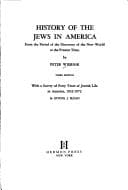
History of the Jews in America: From the Period of the Discovery of the New World to the Present TimeWiernik, Peter
History
History of the Jews in America: From the Period of the Discovery of the New World to the Present Time
Wiernik, Peter
Jews -- America -- History; Jews -- United States -- History
The ♦separation of Church and State was therefore a practical necessity,
based on causes which were deeply rooted in the life of the people. It
was almost a forced step on the way of development, not an enthusiastic
outburst in favor of an abstract principle. This is why the ground
which was then gained was never lost again, why there was no reaction
and no reversion to the former order of a religious establishment as
happened in France after the great revolution which began in 1789.
The moderate, self-restrained liberalism of the colonists held its own
after the struggle was over and kept on progressing slowly. The violent
radicalism of the older country went so far that many steps had to
be retraced, and the fight of separating Church and State had to be
fought out all over again in our own time, more than a century after
all religion was abolished during the reign of terror.
A letter sent by an unnamed German Jew on behalf of himself and his
brethren to the President of the Continental Congress, in which the
wretched condition of the Jews in Germany at that time is depicted, and
their desire to become subjects of the thirteen provinces is expressed,
appeared in the _Deutsches Museum_ of June, 1783, and four years later
a separate edition of it was published under the title, _Schreiben
eines deutschen Juden an den Nord Amerikanischen Präsidenten_.[14]
As there is no record of its reception or discussion in America,
it probably attracted very little attention. The same is also true
of the letter which Jonas Phillips (b. in Rhenish Prussia, 1736;
d. in New York, Jan. 28, 1803), of Philadelphia, sent to the Federal
Convention in relation to the removal of the test oath in Pennsylvania
which discriminated against Jews and those who did not subscribe to
Christian doctrines (Sept. 7, 1787). When the fundamental law of the
land was adopted there were no exciting debates about the question of
religious liberty. The clause abolishing religious tests in the Federal
Constitution passed almost unanimously; the State of North Carolina
alone voted against it, and as there were hardly any Jews there at
that time, the fear of the Roman Catholics was the only cause for the
illiberal stand taken by its representatives. The extent of that fear
can be understood from the fact that when the State Convention of North
Carolina to adopt the Federal Constitution convened in Hillsborough, in
July, 1788, pamphlets were circulated “pointing out in all seriousness
the danger of the Pope being elected President should the Constitution
be adopted.” (See Hühner, _Religious Liberty in North Carolina_,
“Publications,” XVI, p. 42). The time for religious liberty as well
as for independence in national affairs had come and was accepted as
a matter of course, and it is the exceptional glory of the American
Revolution that all the liberties won were retained and the young
nation was enabled to continue on the way of progress unhindered by
Public-domain text, read in full here on John Shaqi.
Reviews
Reviews
No reviews yet
Be the first to share your thoughts on this work.
Join the Discussion
Join the discussion
Sign in to leave a comment or review.
Sign InorCreate an account