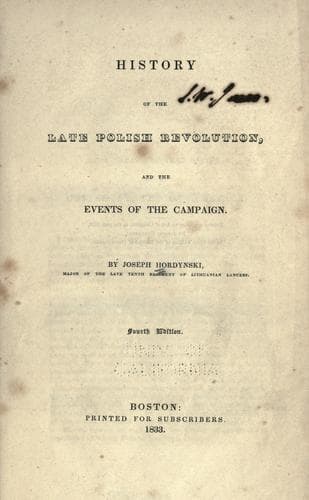
History of the Late Polish Revolution and the Events of the CampaignHordynski, Joseph
History
History of the Late Polish Revolution and the Events of the Campaign
Hordynski, Joseph
Poland -- History -- Revolution, 1830-1832
It had pleased Providence thus far to make the success of our arms, in
every point, a just chastisement of our enemy, and encouraged by this
success, the nation had begun to cherish the brightest hopes for the
future. Their confidence and exultation were complete, when the report
was received, that our brethren in Lithuania and Samogitia had risen
to break the yoke of despotism, and had openly commenced a revolution.
The certain confirmation of this happy intelligence was brought to the
kingdom by one of the students of the University of Wilno. This brave
young man belonged to the patriotic club which had been secretly formed
there, and that club had sent him to Warsaw to carry the authentic
intelligence of the insurrection.[51]
Then it was, at last, that the voice of liberty was heard upon the
shores of the Baltic, and at the sources of the Dwina and the Niemen;
and with this voice, was heard that of union with ancient Poland. The
brave inhabitants of this immense region, animated with an attachment
for us, the strength of which ages had proved, regarded themselves only
as a part of one great family with ourselves. Almost within hearing
of the bloody combats which had been fought, they could not restrain
themselves from joining in the struggle, and acting side by side with
us, for our common Poland.
Before I enter upon the details of this revolution in Lithuania,
the reader will permit me to refer him, in the Appendix, to a short
description of that country and a view of its connection with Poland,
which is, in general, so imperfectly understood.
The Lithuanians of Wilno knew, four days after the 29th of November,
that Warsaw had given the signal of a new Polish insurrection. A
deputation was immediately sent by them to the dictator Chlopicki,
announcing to him _that all Lithuania, and particularly the Lithuanian
corps d'armee, of 60,000 strong, was ready to pass to the side of the
Poles_. But that inexplicable and lamentable dictatorship _rejected
this offer_, so great and so generous. The Lithuanians, however, not
despairing, waited for a more propitious moment; and scarcely was the
dictatorship abolished, when the national government,--thanks to the
thoughtful care of Joachim Lelewell,--addressed itself officially to
the Lithuanian committee. Every disposition was made for a rising at an
appointed time, which at length arrived.
Public-domain text, read in full here on John Shaqi.
Reviews
Reviews
No reviews yet
Be the first to share your thoughts on this work.
Elsewhere in the archive
Join the Discussion
Join the discussion
Sign in to leave a comment or review.
Sign InorCreate an account