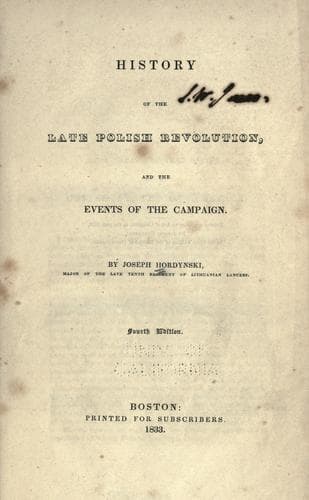
History of the Late Polish Revolution and the Events of the CampaignHordynski, Joseph
History
History of the Late Polish Revolution and the Events of the Campaign
Hordynski, Joseph
Poland -- History -- Revolution, 1830-1832
Many of the patriots, for the purpose of consulting upon the different
arrangements for the revolt, had secretly assembled on the last of
March at Osmiany, and held their secret conferences in the church of
the place. While occupied in this manner, a loud shouting was heard
in the town. A regiment of cossacks had entered the place, and a great
part of the regiment surrounded the church. The doors were broken down,
and the cossacks entered and sabred the unfortunate men within these
sacred walls. Wounded as they were, those who survived the attack were
thrown into wagons to be carried to Wilno. But in this the barbarians
did not succeed. A few escaped from their bloody hands, ran into the
suburbs of the town and collected the peasantry, and on that very
night, some hundreds of the inhabitants having been got together,
Osmiany was attacked with the greatest fury by the patriots. Several
hundreds of cossacks were massacred. The others took flight, and the
poor prisoners were delivered. From that moment the flame spread to the
departments of Wilno, Wilkomierz, Rosseyny, and Szawla. In a few weeks,
more than twelve towns were taken by storm, and the Russian garrisons
driven out and dispersed. The principal of these towns were Jarbourg,
Szawla, Keydany, Wilkomierz, Kowno, Troki, Swienciany, Rosienice,
and Beysagola. In a short time, more than a thousand Russians fell
under the blows of the Lithuanians, and another thousand were taken
prisoners. The Lithuanians accoutred themselves with their arms. Some
hundred horses, and several pieces of cannon were also taken. The most
bloody affair was the storm of Wilno, on the night of the 4th of April.
Two hundred Lithuanians attacked this town, and fought with 4,000
Russian infantry, (nearly two regiments,) six squadrons of cavalry, and
twelve pieces of cannon. For the whole night, the Lithuanians pressed
their attack with fury. They took the powder magazine and arsenal,
where they found many arms. But the most consolatory success was, the
rescuing of some hundred patriotic students, and proprietors, who had
been confined in prison there for years. The battle of Keydany and
Szerwinty was also severe, and the valor of the brave Lithuanians was
equally displayed there. At Keydany, twenty of the brave youths of the
academy defended the bridge over the Niewiaza, against two squadrons of
cavalry, while, on the other side, some hundreds of those brave youths
made a storm upon the city, and routed the garrison, which consisted
of three squadrons of hussars. In a word, not quite 2,000 Lithuanians,
armed in the most defective manner, commenced the struggle, and drove
out garrisons to the amount of eight or ten thousand Russian regular
troops, spreading consternation throughout the whole of the enormous
space between the Dwina and the Niemen. Their numbers were soon
augmented, and armed with weapons taken from the Russians. Their forces
were afterwards divided into several small detached partizan corps,
Public-domain text, read in full here on John Shaqi.
Reviews
Reviews
No reviews yet
Be the first to share your thoughts on this work.
Elsewhere in the archive
Join the Discussion
Join the discussion
Sign in to leave a comment or review.
Sign InorCreate an account