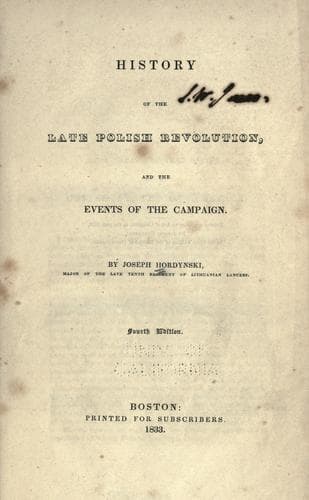
History of the Late Polish Revolution and the Events of the CampaignHordynski, Joseph
History
History of the Late Polish Revolution and the Events of the Campaign
Hordynski, Joseph
Poland -- History -- Revolution, 1830-1832
The reader will permit me to fix his attention upon the epoch of
the battle of Iganie, which was indeed the brightest moment of our
war, the moment of the highest success of the Polish arms, the
moment of the most confident hopes, when every Pole in imagination
saw his country already restored to her ancient glory. Let us then,
from this point, cast a look backwards to the commencement of this
terrible contest. Two months before, an enormous Russian force had
invaded our country, defended as it was by a mere handful of her
sons; and any one who had seen that immense army enter upon our soil,
could not but have looked on Poland with commiseration, as about to
be instantaneously annihilated. In this expectation, in fact, all
Europe looked on, and at every moment the world expected to hear of
the terrible catastrophe,--to see Poland again in chains, and the
Russian arms reposing on the borders of the Rhine. Such, in fact,
were the expectations and even the promises of marshal Diebitsch.
Providence, however, willed otherwise. The first shock of the Polish
arms with the Russians taught the latter what was the moral strength of
patriotism,--what a nation can do for love of country and of liberty.
The fields of Siedlce, Dobre, and Stoczek, the first witnesses of
our triumphs, and the grave of so many of our enemies, taught them
to respect the nation which they expected to subdue, made them
repent the audacity of having passed our frontiers, and gave them a
terrible presage of how dearly they would have to pay for this unjust
invasion of our soil. Battle upon battle was given, in which the
enemy were uniformly subjected to the severest losses. The two great
roads leading from different directions to Warsaw, on which they had
followed the Poles, were covered with their dead. Thus subjected to
loss at every step, the enemy reached at last the field of Praga, and
there collecting all his forces in one body, under a tremendous fire
of artillery he thought to overpower our small forces. But he failed
to do it. The immortal day of the 25th of February was nearly the
destruction of his enormous force, and, after fifteen days of severe
fighting, that great army, which was designed to destroy Poland and to
make Europe tremble, was brought to a state of extremity. The autocrat
and his general blushed at the menaces which they had uttered. Poland
believed that the former would reflect upon those bloody struggles
and the immense losses which he had suffered, and would be unwilling
to continue such sacrifices. Nearly 50,000 Russians were already
sacrificed. How many more lives might he not still lose? The Poles,
although conquerors, held out the hand of reconciliation, as the
letters that Skrzynecki addressed to Diebitsch have proved. In those
letters, written with the utmost cordiality, frankness, and directness,
he invited the Russian commander to present the real state of things to
the monarch, and to assure him that the Poles longed to put an end to
Public-domain text, read in full here on John Shaqi.
Reviews
Reviews
No reviews yet
Be the first to share your thoughts on this work.
Elsewhere in the archive
Join the Discussion
Join the discussion
Sign in to leave a comment or review.
Sign InorCreate an account