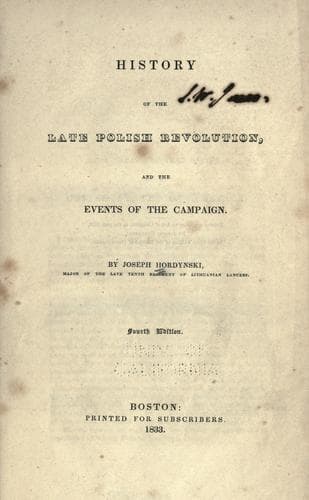
History of the Late Polish Revolution and the Events of the CampaignHordynski, Joseph
History
History of the Late Polish Revolution and the Events of the Campaign
Hordynski, Joseph
Poland -- History -- Revolution, 1830-1832
[Footnote 54: I cannot pretend to give the reader an accurate idea
of the number of prisoners which were taken during the first days of
April. From the battle of Wawr to that of Iganie, not a day passed in
which great numbers of them, with baggage and effects of all kinds,
were not brought in. They must have amounted in that interval to full
16,000. Those prisoners arrived generally without escort, and it was
often the case that old men and even women of the peasantry were seen
leading them, or rather showing them the way,--two or three peasants,
perhaps, with twenty prisoners. This continual influx of prisoners gave
a name in fact to that interval of time, which was referred to, as 'the
Period of the Prisoners.' The inhabitants of Warsaw found an amusement
in witnessing this continual arrival of the captured Russians. 'Let us
go to Praga, to see the prisoners brought in,' was a proposition often
made, as referring to an ordinary recreation which might be counted on
with perfect certainty. If, for a half day, no prisoners appeared, the
complaint would be sportively made, 'What is Mr John about, (referring
to Skrzynecki) that he sends us no prisoners to-day?'
The great number of the prisoners engaged the attention of the national
government. It was impossible to leave them all at Warsaw; and they
were at first divided into three parts, one of which remained in Warsaw
to work upon the fortifications, and every soldier was paid for his
labor. The second part being also employed upon wages, labored on the
great roads leading from Warsaw, in a direction opposite to the seat
of the war. The third part were dispersed among the farmers in the
proportion of one Russian for three farmers; and these were also paid
for their labor. At stated times, an assemblage of the prisoners was
held, in which they were addressed in such a manner as to produce a
moral effect upon them. They were instructed in the true nature of
their political rights, the real causes of the contest were exhibited
to them, and they were made to be convinced that it was for their
advantage as well as our own that we were fighting.
The greatest harmony reigned between the Poles and their prisoners;
and I am sure that those Russians will remember the days they passed
as prisoners, as the happiest in their lives. With us their prison was
a state of freedom and tranquillity, in which they received a liberal
reward for their labor, while in their own country they were the slaves
of despots, great and little, to whom obedience was enforced by the
knout.]
CHAPTER XVI.
Public-domain text, read in full here on John Shaqi.
Reviews
Reviews
No reviews yet
Be the first to share your thoughts on this work.
Elsewhere in the archive
Join the Discussion
Join the discussion
Sign in to leave a comment or review.
Sign InorCreate an account