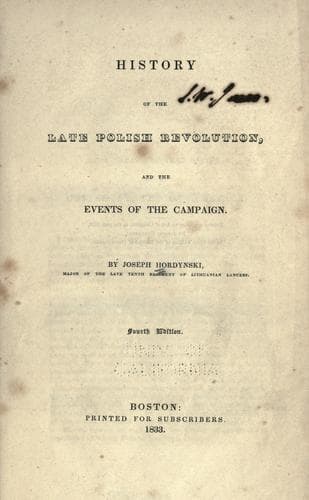
History of the Late Polish Revolution and the Events of the CampaignHordynski, Joseph
History
History of the Late Polish Revolution and the Events of the Campaign
Hordynski, Joseph
Poland -- History -- Revolution, 1830-1832
After his plans for the defence of Warsaw were communicated to the
authorities of the city, he gave particular attention to those points
on which he intended to support all his operations, and, relying on
which, he could at any time hazard the boldest attempts. Having thus
made Warsaw an axis, upon which all his operations could revolve, he
proceeded to arrange his attack. In the first place he sent orders
to general Dwernicki (_h_) to attack immediately the combined corps
of generals Witt and Kreutz (_d_). In this attack the small corps of
general Sierawski (_g_) was to aid, and the two corps were to preserve
a constant communication with each other. For that object general
Sierawski was to pass the Vistula at Kazimierz (12), and, avoiding an
engagement with the enemy, to endeavor to join, as soon as possible,
the corps of general Dwernicki, who received orders to leave Zamosc and
approach Lublin (13). These two corps were to take such a position,
that they could at any time retire upon Zamosc or Kazimierz. General
Dwernicki was also informed that a third small corps would be sent in
the direction of Zelechow (7) and Kock (2), to act in concert with him
on the enemy's rear. If they should succeed in the attack, general
Dwernicki was to endeavor to force the enemy to take the direction of
Pulawy (9), to drive him into the angle formed by the Vistula (V) and
the Wieprz (P); in fine, so to act as to cut off those two corps from
all communication whatever with their main body. Leaving the corps
of general Sierawski to continue to observe them, and to push his
advantages over them, Dwernicki himself was to pass the Wieprz at Kock,
and from thence by forced marches to leave in the direction of Radzyn
(11) for Lukow (1) or Seroczyn (14), as circumstances might direct,
and according as he should ascertain the position of the enemy to be.
Arrived at Lukow or Seroczyn, as the case might be, he was to await
there the orders of the general in chief, to join in the attack upon
the main force of the enemy under Diebitsch (_e_), in which attack he
was to act on the enemy's left wing. The main body of the enemy, thus
taken in front and in flank, simultaneously, could not but have been
broken up. For all these operations the general in chief had destined
fourteen days only.
On the night of the battle of Iganie, the general in chief having
decided upon the above plan, sent officers in every direction with
orders and instructions. The officers sent to the corps of general
Dwernicki were enjoined to communicate their orders to him with the
utmost haste.
Public-domain text, read in full here on John Shaqi.
Reviews
Reviews
No reviews yet
Be the first to share your thoughts on this work.
Elsewhere in the archive
Join the Discussion
Join the discussion
Sign in to leave a comment or review.
Sign InorCreate an account