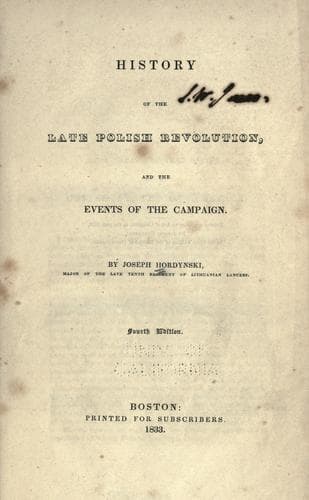
History of the Late Polish Revolution and the Events of the CampaignHordynski, Joseph
History
History of the Late Polish Revolution and the Events of the Campaign
Hordynski, Joseph
Poland -- History -- Revolution, 1830-1832
To these disasters of the two corps of Dwernicki and Sierawski, which
were deeply felt by the nation, was now to be added the appearance of
that horrible malady, the cholera, which after the battle of Iganie
commenced its devastations in our ranks. On the night of that battle
several hundreds of our troops fell sick. This terrible disease caused
us, on the first few days, the loss of nearly 1,000 men; but if it
was terrible with us, nothing can express the suffering it produced
in the Russian camp, aided by the want of comfort in the arrangements
of that camp, and the acid food upon which the Russian soldiers were
habitually fed. Thousands of those wretched sufferers were left exposed
to the open air, and died upon the field. The Poles took even more
care of them than of their own sick. They were brought together, and
transported to Menie, where there was a large convent, which was turned
into an hospital for their use. The total number of those sufferers
may be imagined, when it is stated, that, in that hospital and village
alone, two thousand Russian sick were reported.
FOOTNOTES:
[Footnote 55: This unfortunate and painful event should serve as an
impressive example, which cannot be too often brought to mind, of
what disastrous consequences may follow from the neglect of observing
a constant communication between corps acting together, and, above
all, the departing from orders which are given upon a general plan,
the absolute control of which should belong to the general in chief.
Had general Dwernicki, conforming to his instructions, acted only
against the corps of Kreutz and Witt, and in concert with the corps
of Sierawski, he would have been apprised of that general's quitting
Kazimierz, and both of those two corps could have joined in the attack,
in which they would have been aided by another corps which was to be
sent, as the reader is aware, to act against the enemy's rear. If those
corps of Kreutz and Witt had been defeated, immense advantages would
have followed; indeed the war would have been over, for the Russian
main army would have been taken in flank and rear, and, in fact,
completely cut off.]
CHAPTER XVII.
The Russian commander resumes offensive operations.--Object of the
attack of the 25th of April.--Combat of Kuflew.--General Dembinski
evacuates the position of Kuflew and awaits the enemy at Bady.--Battle
of Minsk.--The enemy suddenly evacuates his position.--Reflections on
this stage of the conflict.--Positions of the two armies.
Public-domain text, read in full here on John Shaqi.
Reviews
Reviews
No reviews yet
Be the first to share your thoughts on this work.
Elsewhere in the archive
Join the Discussion
Join the discussion
Sign in to leave a comment or review.
Sign InorCreate an account