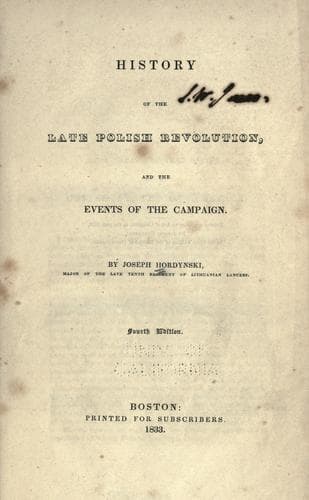
History of the Late Polish Revolution and the Events of the CampaignHordynski, Joseph
History
History of the Late Polish Revolution and the Events of the Campaign
Hordynski, Joseph
Poland -- History -- Revolution, 1830-1832
This combat deserved to be forever held up as an example in tactics,
to show how much can be done with a small force, managed with prudence
and skill. Colonel Dembinski, who, in this battle, commanded the
inconsiderable forces that met the attack of the masses of Diebitsch,
well merited the rank of general, to which he was then advanced. Our
position was covered by the river Swider (S) and its marshes, which
secured it from being taken in flank. The enemy had one debouchment
(_a_), consisting of a kind of dyke, which led from Kolacze (1). He
could pass this dyke easily, for the bridge was entire. On our side,
not far from this dyke, were small forests, or rather brush-wood,
occupied by two battalions (_b_) of our infantry. Upon the plain
between Kuflew and the river Swider, ten squadrons of our cavalry
(_c_) manoeuvred. Near the village (II) upon a little hill, on which
was a wind-mill, our artillery (_d_), consisting of only four pieces,
were posted, and directed their fire upon the passage over which the
enemy were to debouch. The position of the enemy was commanding, for
his artillery could sweep the whole plain on each side of the Swider.
The details of this battle were as follow:--At sunrise, on the 25th,
several regiments of cossacks (_e_) appeared upon the heights of
Jeruzalem. They even several times attempted to pass the dyke, but were
repulsed by the fire of our tirailleurs from the brush-wood. It was
mid-day when strong columns of infantry (_f_) began to show themselves
in the direction of Lukowiec and Plomieniec. In a short time all the
heights of Jeruzalem were covered with columns of infantry, and they
began their descent to Kolacze. The Russian light troops (_g_) began
their debouchment, and a warm fire commenced between the Russian
infantry upon the dyke, and our own tirailleurs in the brush-wood. The
Russian artillery (_h_) which remained upon the heights on the other
side, consisting of twenty and more pieces of large calibre, poured
for several hours a heavy fire upon Kuflew, where they supposed a
large force to be placed, but where, in fact, besides the four pieces
of artillery, we had but one company of infantry. Under this terrible
fire, that village was burnt to the ground. Those attacks of the
Russian artillery and infantry continued for three successive hours,
when colonel Dembinski, being informed that the small detachments at
Latowicz, &c, above referred to, had evacuated their position and were
safe from being cut off, commenced his retreat, as his instructions
directed. By accelerating his retreat he had another object in view,
namely, to lead the enemy in the direction of the 2d division, which
was posted at Ceglow, and was prepared to receive him. Our infantry and
artillery had left their position and were on the road, when colonel
Dembinski, placing himself at the head of his cavalry, threw himself
with great boldness upon the columns of the enemy which had debouched
Public-domain text, read in full here on John Shaqi.
Reviews
Reviews
No reviews yet
Be the first to share your thoughts on this work.
Elsewhere in the archive
Join the Discussion
Join the discussion
Sign in to leave a comment or review.
Sign InorCreate an account