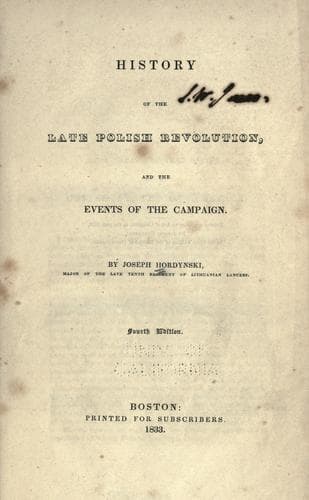
History of the Late Polish Revolution and the Events of the CampaignHordynski, Joseph
History
History of the Late Polish Revolution and the Events of the Campaign
Hordynski, Joseph
Poland -- History -- Revolution, 1830-1832
all its baggage, ammunition, &c, and as many as two thousand prisoners
and six pieces of artillery fell into our hands. The remains of his
force fled along the great road (D), which was purposely left open to
him. General Chrzanowski contented himself with occupying the town, in
which he furnished himself with ammunition from the magazines, and,
remaining there but a short time, left for the environs of Zamosc, in
which fortress he deposited his prisoners.
Conformably to his instructions, he remained in camp, near this
fortress, at Labunia.[57]
The general in chief having thus accomplished his object of supplying
the place of general Dwernicki's corps, and holding in check the
corps of Witt and Kreutz, in the palatinate of Lublin, it remained to
him to complete his great plan by sending a corps into Lithuania. He
decided to remove the only obstacle to this attempt by attacking the
Russian imperial guard, which was somewhat detached from the Russian
grand army. To carry this bold purpose into effect, the following
instructions were given to the different commanders.
[Illustration:
_XXIX._]
[Illustration:
_XXX._]
OPERATIONS AGAINST THE RUSSIAN GUARD. [_Plan_ XXIX.]
On the 12th of May, general Uminski with his division of cavalry (_a_)
was ordered to quit the left wing and the position of Zimna-Woda, and
to move to the position of Kaluszyn. This traverse of the line he was
to make in full view of the enemy, and he was to give to the manoeuvre
the aspect of a reconnoissance. The object of this change of position
was, that in the new position he might mask the movements of the main
body. This important disposition general Uminski was directed to carry
into effect with the utmost prudence. The enemy was to be each day
harassed, but never to be engaged with in any decisive manner. Small
detachments were to be sent against the enemy, along his whole line,
and especially on the first days of the movement. The general in chief
instructed general Uminski to watch every movement of the enemy, and
give information of such at head-quarters. If the main body of the
Russian force should make an attack, he was to execute his retreat upon
the main road, as far as the fortifications of Praga, and there he
was to act in junction with the other detachments left there for the
defence of those fortifications. If, on the contrary, the Russian army
should make a retrograde movement, general Uminski was to endeavor,
by following them, to keep them constantly in view. If circumstances
permitted, the rear guard of the Russians might be harassed during
the night. Above all, general Uminski was to endeavor to keep up his
communications with the neighboring corps, that of general Lubinski,
and the detachments left at Siennica and Karczew. In this moderate
pursuit of the enemy, the general was to ascertain whether their
retrograde movement was a retreat or a manoeuvre, in order to avoid
every hazard.
Public-domain text, read in full here on John Shaqi.
Reviews
Reviews
No reviews yet
Be the first to share your thoughts on this work.
Elsewhere in the archive
Join the Discussion
Join the discussion
Sign in to leave a comment or review.
Sign InorCreate an account