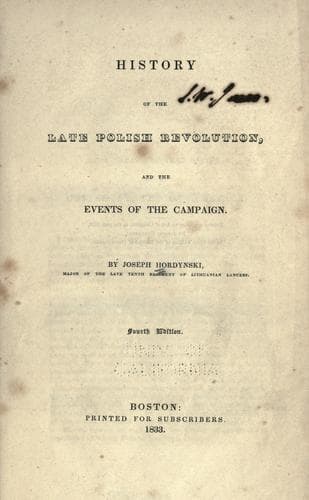
History of the Late Polish Revolution and the Events of the CampaignHordynski, Joseph
History
History of the Late Polish Revolution and the Events of the Campaign
Hordynski, Joseph
Poland -- History -- Revolution, 1830-1832
Our army, having halted one day at Xienzopol, on the evening of the
20th, quitted this position to continue the pursuit of the guard, and
overtook them in the forest of Menzynin (15). This forest, occupied by
the Russian rear-guard, was so near the heights of the village, which
command the whole vicinity, that it was exposed to a fire of artillery
from these heights. Our generalissimo placed his artillery on the
heights, and directed a fire upon the forest; the infantry was ordered
to take the enemy in front, in case he should quit the forest, and the
cavalry was to advance in strong columns along the road, to cut off his
escape from the forest into the road. In this they were successful, and
took many prisoners. Thus continually pursued, and subject to severe
losses along the whole route, the guard (_l_) was again pressed at the
passage of the Narew at Tykocin (16). The consternation and disorder of
the enemy was such, that he did not take time to destroy the bridge.
Our lancers, commanded by the brave colonel Langerman, commenced an
attack upon the Russian cuirassiers, on the bridge itself. The regiment
of cuirassiers was almost annihilated, many being thrown from the
bridge, and a great number taken prisoners.
Having thus driven the Russian guard from the kingdom, (of which the
Narew was the boundary,) general Skrzynecki commenced a retrograde
movement, to meet the demonstration which general Diebitsch might make
upon his rear. On the night of the 22d, our army (_m_) began this
movement, having destroyed the several bridges of the Narew.
These then are the details of the operations upon the Russian guard,
which will be admitted to be among the finest in the history of modern
warfare. The operations of Napoleon, in the campaign of Italy--the
brilliant commencement of his career, in 1796,--will be always cited
as the highest examples of stratago-tactics, but I do not think that a
finer and bolder plan of operations can be found even there. In both
cases, success was owing, not more to the great military genius of the
leaders, than to those high moral impulses which must animate armies in
every contest for national existence.
Our army, evacuating on the 12th, the position at Kaluszyn, from that
date to the 26th, when the battle of Ostrolenka took place, had passed
over a distance of from 200 to 250 miles, which, deducting the six
days occupied in action, was executed in eight days, making an average
of twenty-eight English miles per day, an extraordinary and perhaps
unexampled effort. The rapidity, in fact, with which this movement
was performed, was such, that our forces were on their return before
marshal Diebitsch commenced his march to intercept them. This object
the marshal thought himself in season to effect, but the reader will
see in the sequel how completely he failed of it.
FOOTNOTES:
Public-domain text, read in full here on John Shaqi.
Reviews
Reviews
No reviews yet
Be the first to share your thoughts on this work.
Elsewhere in the archive
Join the Discussion
Join the discussion
Sign in to leave a comment or review.
Sign InorCreate an account