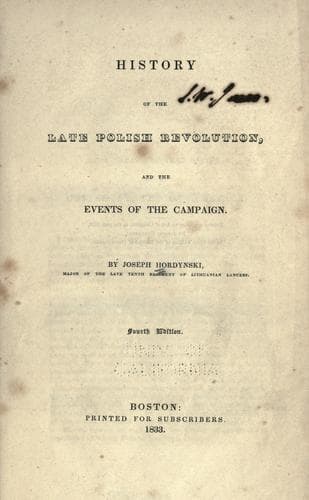
History of the Late Polish Revolution and the Events of the CampaignHordynski, Joseph
History
History of the Late Polish Revolution and the Events of the Campaign
Hordynski, Joseph
Poland -- History -- Revolution, 1830-1832
After the departure of the aid-de-camp, general Lubinski commenced his
march, and, though it was practicable for him to reach Ostrolenka by
a direct route, yet thinking it possible that Czyzew was not occupied
by a very strong force, and that he might profit by the approach of
night, he determined to march at once upon the latter place, and to
attack the Russian advanced guard there. This bold thought was executed
with perfect success. On reaching Czyzew he found two regiments of
cavalry encamped, and wholly unprepared for an attack. They had not
even an outer-guard upon the road to Nur. He made a charge which threw
them into complete disorder, and compelled them to retreat with the
loss of a great number in killed and wounded, and four to five hundred
prisoners. It was to be regretted that the necessity under which
general Lubinski was placed of reaching Ostrolenka as soon as possible,
did not permit him to profit farther by these advantages.
On the next day, (the 25th) the rear-guard of our main army, consisting
of the brigade of general Wengierski, was attacked at mid-day by the
Russians, on the side of Zambrowo, near Kleczkowo (20), a village
situated at the distance of three leagues from Ostrolenka, on the left
bank of the Narew. General Diebitsch, being under the conviction that
he had encountered the whole Polish force at Kleczkowo, consolidated
his strength there, and determined to come to action, and, by so doing,
give time for another corps to advance in the direction of Czyzew, and
occupy Ostrolenka, by which movement he trusted that our army would
be cut off from Warsaw, and forced to retire to Lomza. The Russian
commander, presuming on the celerity of his movements, was so confident
of meeting our whole army at this point, that nothing could exceed his
surprise on learning that our army had already passed the town, and
that it was only the rear-guard which was before him.[61] In order to
lose no time, he commenced an immediate attack on the rear-guard thus
posted at Kleczkowo. Our general in chief who was then at Troszyn, on
hearing the fire of the Russians at Kleczkowo, immediately repaired
thither, and profiting by the fine position of that place, which
commanded the marshy plain on the side of the enemy, passable only
by a dyke, the bridge over which had been demolished by our troops,
ordered general Wengierski to sustain himself in that position until
night. In vain the Russian cavalry and infantry attempted to pass this
dyke. At each approach they were uniformly driven back by a destructive
fire of grape from our artillery. In vain were sixteen pieces of
their artillery employed to silence this fire; our position was too
commanding to be affected by them.
Public-domain text, read in full here on John Shaqi.
Reviews
Reviews
No reviews yet
Be the first to share your thoughts on this work.
Elsewhere in the archive
Join the Discussion
Join the discussion
Sign in to leave a comment or review.
Sign InorCreate an account