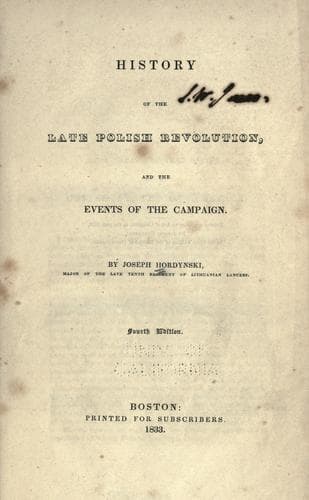
History of the Late Polish Revolution and the Events of the CampaignHordynski, Joseph
History
History of the Late Polish Revolution and the Events of the Campaign
Hordynski, Joseph
Poland -- History -- Revolution, 1830-1832
[Footnote 60: The officer announced to general Lubinski that the
whole Russian army had occupied Ciechanowiec, that the advanced guard
was already at Czyzew, and that those circumstances ought to satisfy
him that his communications with his friends were entirely cut off,
and that therefore he would do well to lay down his arms and throw
himself upon the magnanimity of the Emperor. To this proposition
general Lubinski replied, that although such might be his situation,
he could not think of surrendering himself without a struggle; and
to satisfy the aid-de-camp that this was not his individual feeling
alone, but that it was partaken by the whole body of his soldiers,
he would present him to them, and enable him to satisfy himself
personally on this point. The aid-de-camp was then conducted to the
front of the line, and he addressed himself to the troops, exhibiting
the circumstances under which they were placed, assuring them that the
bravest resistance would be hopeless, and inviting them to surrender.
This address was interrupted by a universal shout of indignation from
the soldiery, and they commanded him to leave their presence. This
division was composed of two regiments of old light infantry, and two
recently formed regiments of Mazurs.]
[Footnote 61: Marshal Diebitsch must by this time have become satisfied
that the operations, both in strategy and tactics, of the Polish
commander, were the result of extensive and just combinations. General
Skrzynecki, in contriving this plan (with the valuable assistance of
general Prondzynski,) of surprising and defeating the Russian guard,
had satisfied himself of the practicability of returning to Ostrolenka
without being intercepted.]
[Footnote 62: The question might be asked by some, whether this battle
was necessary, and why general Skrzynecki did not pursue his route
to Warsaw, as he could have done without molestation. In the course
which he took, he had two objects in view; the one was, to cause this
destructive passage of the Narew, and thus diminish the forces of his
enemy; the other was, by thus occupying general Diebitsch to give time
to general Gielgud to leave Lomza in safety for Lithuania. (_See Plan_
XXIX.)]
[Footnote 63: This fire of the Russian artillery might almost be
compared to the terrible fire of the 25th of February, at Grochow, in
the attack on the forest of elders.]
Public-domain text, read in full here on John Shaqi.
Reviews
Reviews
No reviews yet
Be the first to share your thoughts on this work.
Elsewhere in the archive
Join the Discussion
Join the discussion
Sign in to leave a comment or review.
Sign InorCreate an account