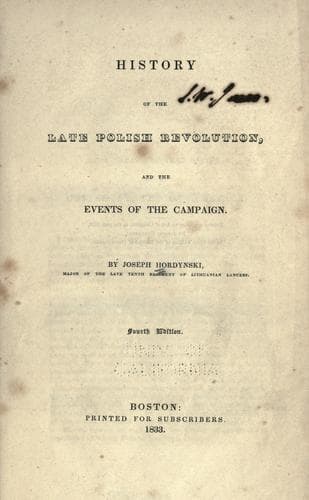
History of the Late Polish Revolution and the Events of the CampaignHordynski, Joseph
History
History of the Late Polish Revolution and the Events of the Campaign
Hordynski, Joseph
Poland -- History -- Revolution, 1830-1832
On the 3d of June, the Russian army, which, up to the present time,
continued in the environs of Ostrolenka, on the left bank of the
Narew, commenced its operations upon the right bank of that river.
A considerable corps, amounting to 20,000 men, passed that river in
the neighborhood of Prasnysz. The principal object of this corps was
not to re-ommence hostilities, but to protect the large transports
of provisions which were sent daily from Prussia. In the environs of
Brzesc was the corps of general Kreutz. The Russian army thus fed by
Prussia, remained inactive in their position at Ostrolenka, during
which interval, and while he was perhaps contriving new plans for our
subjugation, occurred the sudden death of marshal Diebitsch. He died at
Kleczkowo, not far from Ostrolenka, on the 9th of June.[69]
The provisional command of the Russian army was taken by general Toll.
If the reader should examine closely the operations of the two armies
after the battle of Ostrolenka, he will, perhaps, be astonished at
their inactivity. He will, however, acknowledge that the blame of that
inactivity cannot rest upon the Polish side. The retreat which we
made was necessary; first, for the sake of the re-organizing of the
army; secondly, for the object of leading the enemy to the environs
of Praga, which were in a state of devastation, and generally into
the region between the Bug and the Liwiec, where he would not be able
to support himself; and in this manner to force him either to attack
the fortifications of Praga, to attempt a passage of the Vistula,
or to evacuate the country. That either of the two first would be
attempted, while the insurrections in Lithuania and Samogitia, &c, were
in progress, and after our success at Raygrod, was hardly to have been
expected; for the one would cost too great a sacrifice of men, and the
other would be attended with too much hazard. If, then, the Russian
forces undertook nothing, it was a consequence of their critical
situation. We can, in fact, safely assume that it was their intention
to evacuate the country; for to have obtained sufficient supplies by
their own means was almost impracticable. When, therefore, this army
remained there, it was only because it was fed by Prussia, who did not
scruple openly to succor the enemy in his perilous position, by sending
enormous transports by the roads of Neydenburg and Mlawa. It was those
transports which saved the Russian army from the utmost extremity.
I leave to the reader to judge, then, whether it was with one enemy
alone that the Poles had to contend. The Prussian government, which
arrested all the volunteers who were passing through its territory to
augment our ranks, and which stopped all the aids of money and arms
sent to us by the generous friends of liberty in other countries, took
every occasion to aid and protect our enemy. If that government has
satisfied its own inhuman will, by this interference to injure a cause
Public-domain text, read in full here on John Shaqi.
Reviews
Reviews
No reviews yet
Be the first to share your thoughts on this work.
Elsewhere in the archive
Join the Discussion
Join the discussion
Sign in to leave a comment or review.
Sign InorCreate an account