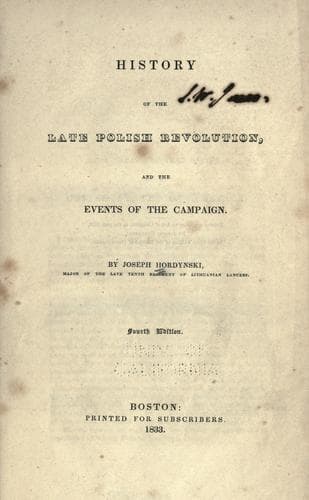
History of the Late Polish Revolution and the Events of the CampaignHordynski, Joseph
History
History of the Late Polish Revolution and the Events of the Campaign
Hordynski, Joseph
Poland -- History -- Revolution, 1830-1832
The battle of Wilno, so disastrous to us, was our greatest fault in the
expedition to Lithuania; and it was the first of a series of disasters.
The evil consequences of this battle did not rest with ourselves; they
fell heavily upon the inhabitants of Wilno, whose hopes of acting in
concert with us were disappointed. At the sound of our cannon, a revolt
of the inhabitants was commenced, and after the repulse of our forces,
arrests and imprisonments of course followed. This unfortunate battle,
in fine, disorganized all the plans of the main army, and had a most
discouraging effect upon the spirits both of the army and the nation.
An attack upon Wilno, at a time when all the enemy's forces were
concentrated there, should only have been made upon the basis of the
most extensive and carefully adjusted combinations. A successful attack
on Wilno would have been a difficult achievement, even by a force
equal to that of the enemy, when the strong positions of the place are
considered. What then shall we say of an attack, with a force amounting
to but one third of that of the enemy, and made also, in broad day,
upon the most defensible point of the enemy's position?
But, as if these disadvantages were not enough, general Dembinski,
after having been compromitted at Myszggola, instead of being enabled
to aid in this attack, was, by the orders of general Gielgud, at the
very moment of the attack, marching in the direction of Podbrzeze,
[(9) _Plan_ XXXIV,] and was also by this separation exposed even to
be cut off by the enemy, who could easily have done it, by sending a
detachment for this object on the road from Wilno to Wilkomierz.
This succession of inconceivable faults arrested the attention of the
corps, and created a universal dissatisfaction. The removal of general
Gielgud, and the substitution of general Chlapowski in the chief
command, who had distinguished himself so much in the departments of
Bialystok and Grodno, was loudly called for. General Chlapowski was
unwilling to take the chief command, but, to satisfy the wishes of the
corps, he consented to take the office of chef d'etat major, a post in
which he was virtually chief, having the exclusive responsibility of
every operation. To this arrangement general Gielgud readily consented.
It took effect on the evening of the 20th. From that day general
Chlapowski was the director of all our operations.
After all these disasters, which had both morally and physically
weakened us, and with a clear knowledge of the amount of the enemy's
strength, our leaders should have been satisfied that it must be out
of the question with us to act any longer on the offensive, and that
our whole plan of operations on Samogitia ought to be abandoned. We
will give the reader an exposition of the views of a great majority
of the officers of the corps, upon this point, formed even during the
battle of Wilno.
Public-domain text, read in full here on John Shaqi.
Reviews
Reviews
No reviews yet
Be the first to share your thoughts on this work.
Elsewhere in the archive
Join the Discussion
Join the discussion
Sign in to leave a comment or review.
Sign InorCreate an account