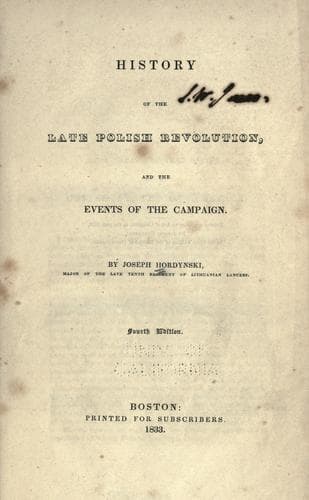
History of the Late Polish Revolution and the Events of the CampaignHordynski, Joseph
History
History of the Late Polish Revolution and the Events of the Campaign
Hordynski, Joseph
Poland -- History -- Revolution, 1830-1832
On the 28th of June, general Skrzynecki received information of a
conspiracy which had for its object the delivering up of Warsaw
into the hands of the enemy, by liberating and arming the Russian
prisoners. Several generals, of whom distrust had been felt, and who
had been deprived of their commands when the revolution broke out,
having been known as the vile instruments of the former government,
were at the bottom of this plot. Of this painful intelligence, general
Skrzynecki immediately apprized the National Government, who, relying
on his report, caused to be arrested general Hurtig, former commander
of the fortress of Zamosc, and a base instrument of Constantine,
general Salacki, colonel Slupecki, the Russian chamberlain Fenshawe,
a Mr Lessel, and a Russian lady, named Bazanow. Generals Jankowski
and Bukowski were also implicated in the conspiracy. This band of
traitors intended to get possession of the arsenal, to arm the Russian
prisoners, and to destroy the bridges; (in order to cut off all
communication with the army, which was then on the right bank of the
Vistula;) and the Russian army, advertised of this movement, was then
to pass to the left bank of the Vistula, at Plock or Dobzyn, and take
possession of Warsaw. Those traitors succeeded in setting at large a
great number of Russian prisoners at Czenstochowa.
What a terror must poor Poland have been to the Russian cabinet, which
did not find it enough to have deluged her with their immense forces,
and to have engaged all the neighboring cabinets to aid them against
her, but must go farther, and, by the employment of such vile means,
attempt to kindle hostilities in her interior, and to subject her at
the same time to a civil and an external war! They had good cause for
these desperate attempts. From the earliest stage of the conflict, they
had seen that the Poles, nerved by the consciousness of the justice of
their cause, were capable of crushing the force which they had sent to
execute the will of the despot. Unable to meet us in the open field,
they must invent some new method, no matter how base, to accomplish
their end. It was through the instrumentality of their intrigues that
the dictatorship was prolonged. It was by such intrigues, that the
apple of discord was thrown into our national congress, and even into
the ranks of that handful of brave men who had sworn to sacrifice
themselves in the cause of their country. They employed their vile
accomplices to betray us, and they succeeded.
Public-domain text, read in full here on John Shaqi.
Reviews
Reviews
No reviews yet
Be the first to share your thoughts on this work.
Elsewhere in the archive
Join the Discussion
Join the discussion
Sign in to leave a comment or review.
Sign InorCreate an account