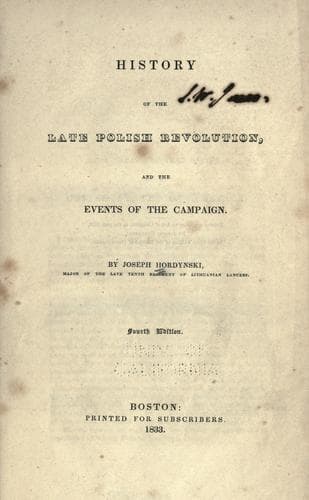
History of the Late Polish Revolution and the Events of the CampaignHordynski, Joseph
History
History of the Late Polish Revolution and the Events of the Campaign
Hordynski, Joseph
Poland -- History -- Revolution, 1830-1832
The cause of this action, which it would have been most desirable to
have avoided, was a strong attack by the enemy upon the rear-guard of
general Chlapowski which was marching on the road to Szawla. To avoid
exposing the rear-guard to a great loss, or even to the chance of it,
the command was given, to take position, and the corps was placed
in order of battle. The battle of Rosseyny, which lasted scarcely
four hours, was very sanguinary, and highly honorable to the Polish
arms. The object of the enemy on this occasion was to surround our
left wing. As soon as he perceived that our corps had taken position
and was arranged in order of battle, the enemy brought forward his
artillery, consisting of 24 pieces of cannon, and commenced a heavy
fire upon our centre. This fire did not cause a great loss, for, our
position being elevated, the shot struck too low to be effective. A few
moments after this fire of artillery was commenced, a strong column
of Russian cavalry showed itself on our right wing. This column had
with it a body of light artillery, which commenced fire also. On our
left wing, which was supported upon a marsh, and, for that reason, in
little expectation of an attack, but a small force was collected. This
wing was composed of a battalion of infantry and the 1st regiment of
lancers. These troops had been placed on this wing to repose from the
combats and fatigues of the day and night preceding, in which they had
acted as rear-guard. The brave lancers, however, at the first sight of
the enemy, demanded of the general to be permitted to make a charge.
This permission being given, at the first discharge of the Russian
artillery, our soldiers threw themselves with impetuosity upon both the
cavalry and the artillery of the enemy. The capture of sixty prisoners
and the spiking of three cannon were the fruits of this brilliant
attack. It was the last charge of that brave regiment.
Our centre was not less fortunate than our left wing. Our artillery
being better placed than that of the enemy, several of his pieces were
dismounted, and his fire began to slacken. For some hours a light fire
of tirailleurs was continued on both sides, when our generals, seeing
that the enemy did not renew the attack, gave orders to evacuate the
position, and to resume the march for Szawla.
Public-domain text, read in full here on John Shaqi.
Reviews
Reviews
No reviews yet
Be the first to share your thoughts on this work.
Elsewhere in the archive
Join the Discussion
Join the discussion
Sign in to leave a comment or review.
Sign InorCreate an account