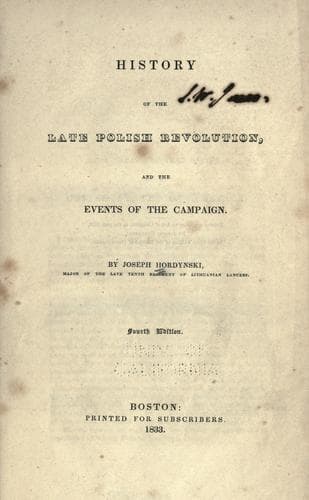
History of the Late Polish Revolution and the Events of the CampaignHordynski, Joseph
History
History of the Late Polish Revolution and the Events of the Campaign
Hordynski, Joseph
Poland -- History -- Revolution, 1830-1832
Since I have allowed myself to make the above remarks in regard to the
plans of the general in chief, I must also be permitted to add that, at
that period of inquietude and distrust, the presence of the commander
in chief and of the president of the National Government, at Warsaw,
was of the utmost importance. That presence was continually needed to
act on the minds of the people, to preserve union and tranquillity,
and to discover and bring to exemplary punishment the traitors who
had been plotting the ruin of their country; in short, to encourage
the patriotic and to alarm the treacherous. If those two individuals
so deservedly beloved and honored by the nation had been present, we
doubt whether those melancholy scenes at Warsaw, on the 14th, 15th,
and 16th of August, when some forty persons who were under conviction
of treason, perished by the hands of the people, would ever have taken
place. Revolting as those scenes were, we must yet consider whether
the circumstances of the moment will not afford some palliation for
them. Deserted by those who had been the objects of their profoundest
attachment and confidence, haunted by the recollections of the terrible
disasters which had been incurred, and which they could attribute to
nothing short of treason,--seeing twenty days again sacrificed, during
which the Russian corps from Lithuania were permitted to pass the
Vistula, (that of Kreutz at Plock, and that of Rudiger at Pulawy,)
and join their main army; in fine, seeing this immense Russian force
approaching the capital, from which perhaps they were expecting a
repetition of all the atrocities of Suwarow,--remembering the thousands
of victims which these traitors had already sacrificed, and reflecting
on the thousands whom they had plotted to sacrifice; can it be wondered
that, in those moments of despair, that people should have yielded to
their impulses of indignation and have chosen rather to sacrifice at
once those convicted traitors, than permit them to live, and perhaps be
the instruments of the vengeance of the conqueror. Abandoned thus by
those who should have been near to tranquillize them, the people took
that justice into their own hands which the government had neglected to
execute, and with their suspicions operated upon by this accumulation
of disasters, they went to the degree of demanding the removal from
their posts of prince Czartoriski and the general in chief.
Public-domain text, read in full here on John Shaqi.
Reviews
Reviews
No reviews yet
Be the first to share your thoughts on this work.
Elsewhere in the archive
Join the Discussion
Join the discussion
Sign in to leave a comment or review.
Sign InorCreate an account