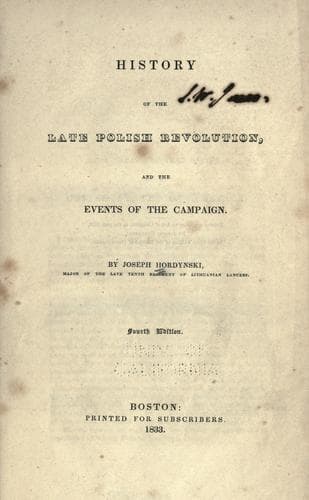
History of the Late Polish Revolution and the Events of the CampaignHordynski, Joseph
History
History of the Late Polish Revolution and the Events of the Campaign
Hordynski, Joseph
Poland -- History -- Revolution, 1830-1832
_Gen. Lafayette_: 'I will ask this, without the least expectation of
receiving a reply, but only to render a just homage to the conduct of
the Poles, and of their government,--I will ask, if it is true that the
Poles were urged by the French government, by the English ministers,
and by the French ambassador at London, to use moderation, and not to
risk a battle, because the measures which those powers were to take in
behalf of Poland would not be delayed but for two months, and that in
two months Poland would enter into the great family of nations.--Those
two months have expired; and I state this here to render justice to the
conduct of the Polish government, the Polish army, and its chief, who
may have thought that on his giving a general battle, to prevent the
passage of the Vistula, they could thwart the good intentions of the
French and English government in this respect. I think that this will
be considered a fair procedure towards Messieurs the Ministers, to whom
the questions shall be addressed on Monday, to apprize them that this
is one of those which will be then submitted to them.'
* * * * *
These documents will be for the present age and for posterity an
explanation of the true causes of the ruin of Poland. She fell not by
the enormous forces of her enemy, but by his perfidious intrigues. We
cannot accuse France or England, and indeed no Pole does accuse them;
for, although we may have some enemies in those countries, yet we
cannot conceive of the existence of any causes of hostility towards
us, by which those nations can be actuated.[83] They were blinded by
the promises of Russia,--by the solemn assurances[84] which she gave,
that she would soon arrange every thing in the most favorable manner
for Poland. In this web of intrigue were those cabinets entangled, who
would else have followed the common dictates of humanity in succoring
Poland. While she was thus deceiving the cabinets, Russia was doing
her utmost to sow distrust and disunion among our people. It was
her intrigues, through the instrumentality of the traitors whom she
had gained for her accomplices, that caused the estrangement of the
nation from Skrzynecki, who, having a true Polish heart, had repelled
all her vile attempts to shake his integrity, and who, by his talent
and energy, had so often defeated and might still defeat the enormous
masses which she had sent against us. Those intrigues succeeded,
and Russia gained her end in overwhelming Poland with misery; not
reflecting that by so doing she was bringing misfortunes upon her
own head. Russia, by a liberal concession to Poland of her national
rights, could have been truly great. Not to speak of the influence
of the Polish institutions upon the happiness of her own people; her
true stability and strength could in no way be so well secured as by
the independent existence of Poland. They who have labored for our
destruction were not then true Russians; they were the enemies of their
Public-domain text, read in full here on John Shaqi.
Reviews
Reviews
No reviews yet
Be the first to share your thoughts on this work.
Elsewhere in the archive
Join the Discussion
Join the discussion
Sign in to leave a comment or review.
Sign InorCreate an account