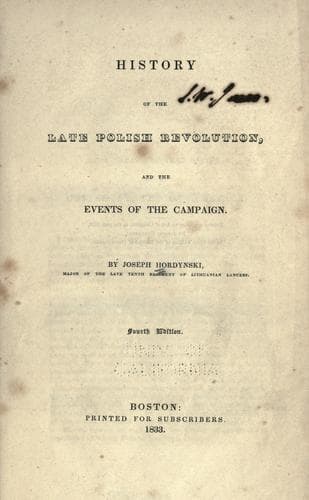
History of the Late Polish Revolution and the Events of the CampaignHordynski, Joseph
History
History of the Late Polish Revolution and the Events of the Campaign
Hordynski, Joseph
Poland -- History -- Revolution, 1830-1832
The partition of Poland has been denominated a crime by the unanimous
voice of Europe, and who at this day will revoke such a decision? Who
will venture to come forward as the champion against it? Undoubtedly
none! And we have the well-grounded hope that Europe will hasten to
recognize our independence, as soon as we have proved by our courage,
our perseverance, our union, our moderate and noble conduct, that we
deserve to be a free nation. This revolution is only a consequence of
our oppression and our misfortunes. It was the wish of our hearts, and
arises from the nature of our history, which displays our determination
from the very beginning, and proves that our rising was not of foreign
prompting. It is not civil war--it is not tainted with the blood of our
brethren--we have not overturned social institutions in order to raise
up new ones at hazard;--it is a war of independence, the most just of
wars. This is the character of our revolution, which is at once mild,
but firm--which with one arm conquers the enemy, and with the other
raises and ennobles the needy peasant.
We admire England and France--we wish to be, like them, a civilized
nation, but without ceasing to be Poles! Nations cannot and ought
not to change the elements of their existence. Each has its climate,
industry, religion, manners, character, education, and history. From
these different elements spring the feelings or passions which display
themselves in revolutions, and the circumstances proper to be adopted
in their future conduct.
Individuality strongly expressed, forms the power of a people. We have
preserved ours in the midst of slavery. Love of country, prepared to
make every sacrifice--courage--piety--noble-mindedness, and gentleness,
formed the character of our forefathers. These qualities also are ours.
The patriots of Warsaw triumphed without chiefs and without law; yet
with what crime can they be charged? An army of 30,000 men, and, in
short, the whole kingdom, rose as if by enchantment; and how did they
conduct themselves towards the Grand Duke Constantine? That prince, who
for fifteen years had shown himself destitute of regard or pity for
our feelings and liberties, was in our power; but he knew the nation,
and, just to it for once only, he intrusted his person and his army
to our honor! At the moment of alarm, we did not listen to the voice
of public vengeance, but respected the prince and his troops, without
taking advantage of our superiority. Our battalions who had awaited
with a firm determination all the forces of Russia, allowed to pass
through their ranks the fallen enemy, whose safety was guaranteed by
the national honor.
Public-domain text, read in full here on John Shaqi.
Reviews
Reviews
No reviews yet
Be the first to share your thoughts on this work.
Elsewhere in the archive
Join the Discussion
Join the discussion
Sign in to leave a comment or review.
Sign InorCreate an account