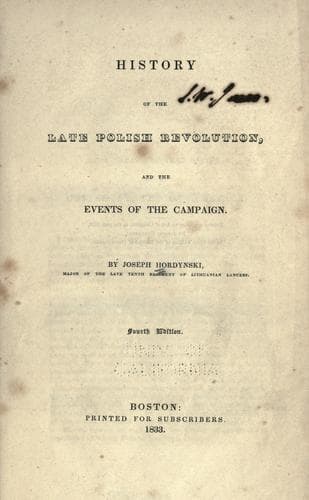
History of the Late Polish Revolution and the Events of the CampaignHordynski, Joseph
History
History of the Late Polish Revolution and the Events of the Campaign
Hordynski, Joseph
Poland -- History -- Revolution, 1830-1832
by a new organic statute, to introduce a new form and order in the
administration of our kingdom of Poland.
'St Petersburgh, February 26, 1832.
'NICHOLAS.
'The Secretary of State, Count Stephen Grabowski.'
After this Manifesto, the organic statutes of Poland are given, the
principal of which are as follows:
* * * * *
'By the grace of God, we, Nicholas I, Emperor and Autocrat of all the
Russias, King of Poland, &c, &c.
'In our constant solicitude for the happiness of the nations which
Providence has confided to our government, we are occupied in fixing
the basis for the future organization of the kingdom of Poland, having
regard to the true interests and positions of the country, and to the
local wants and manners of the inhabitants.
'GENERAL DISPOSITIONS.
'Art. 1. The kingdom of Poland is forever to be re-united to the
Russian empire, and form an inseparable part of that empire. It shall
have a particular administration conformably to its local necessities,
as well as a civil and military code. The statutes and the laws of
cities and towns remain in full vigor.
'Art. 2. The Crown of the kingdom of Poland is hereditary in our person
and in our heirs and successors, agreeably to the order of succession
to the throne prescribed by all the Russias.
'Art. 3. The Coronation of the Emperors of all the Russias and Kings
of Poland shall be one and the same ceremonial, which shall take place
at Moscow, in the presence of a deputation from the kingdom of Poland,
which shall assist at that solemnity with the deputies from the other
parts of the empire.
'Art. 4. In the possible event of a regency in Russia, the power of
the regent or regentess of the empire will extend over the kingdom of
Poland.
'Art. 5. The freedom of worship is guarantied; every one is at liberty
to exercise his religion openly, under the protection of Government;
and the difference of Christian faiths shall never prove a pretext for
the violation of the rights and privileges which are allowed to all the
inhabitants. The Roman Catholic religion, being that of the majority of
our Polish subjects, shall be the object of especial protection of the
Government.
'Art. 6. The funds which the Roman Catholic clergy possess, and those
of the Greek church united, shall be considered as the common and
inviolable property of the hierarchy of each of those creeds.
'Art. 7. The protection of the laws is assured to all the inhabitants
without distinction of rank or class. Each shall be empowered to assume
dignities or to exercise public functions, according to his personal
merits or talents.
'Art. 8. Individual liberty is guarantied and protected by the existing
laws. No one shall be deprived of his liberty, or called to justice, if
he be not a transgressor of the law in all the forms prescribed. Every
one detained shall be apprised of the motive of arrest.
Public-domain text, read in full here on John Shaqi.
Reviews
Reviews
No reviews yet
Be the first to share your thoughts on this work.
Elsewhere in the archive
Join the Discussion
Join the discussion
Sign in to leave a comment or review.
Sign InorCreate an account