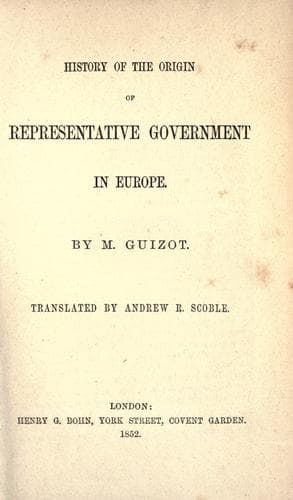
History of the Origin of Representative Government in EuropeGuizot, François
History
History of the Origin of Representative Government in Europe
Guizot, François
Europe -- History; Representative government and representation
We may conclude that lands were most probably distributed in the
following manner. Each chief took a portion for himself and his
associates, who lived on the land of their chief. It would be
absurd to suppose that each band would dissolve itself, and the
separated individuals then retire each to his isolated share of
land; there were no individual shares, or, certainly, but few.
This is sufficiently proved by the fact that the greater number
of Franks appear to have been without landed property, living as
cultivators on the lands, and in the _villæ_ of a chief, or
of the king. Often, even, a man would place himself not only
under the protection, but at the disposal of another, to serve
him during his life, on condition of being fed and clothed, and
yet without ceasing to be free. This kind of contract, the
formula for which has been preserved, must have been very common,
and explains the circumstance that so large a number of free men
are found to have lived and served on lands not belonging to
themselves. Probably, the number of Franks who became
successively proprietors, by means of benefices, was greater than
the number of those who were primitively allodial proprietors.
The larger number ol small allodial proprietors were gradually
robbed of their possessions, or reduced to the condition of
tributaries, by the usurpation of their neighbours, or of
powerful chiefs. Of this, there are innumerable examples. The
laws made, from the seventh to the tenth century, give evidence
of the tendency of large allodial estates or benefices to absorb
small freeholds. The statute of Louis the Debonnair, referring to
the complaints of the Spanish refugees in the south, explains
pretty accurately the system according to which properties
changed hands.
{112}
Donations to churches also tended incessantly to reduce the
number of allodial estates. They would probably soon have
disappeared altogether, had not a cause of an opposite character
tended continually to create new ones. As allodial property was
sure and permanent, while benefices were precarious and more
dependent, the proprietors of benefices constantly sought to
convert their benefices into allodial estates. The capitularies
which remain to us prove this at every step. It is probable that
large new allodial estates were thus created, but small ones
tended to disappear.
Beneficiary Lands.
Public-domain text, read in full here on John Shaqi.
Reviews
Reviews
No reviews yet
Be the first to share your thoughts on this work.
Elsewhere in the archive
Join the Discussion
Join the discussion
Sign in to leave a comment or review.
Sign InorCreate an account