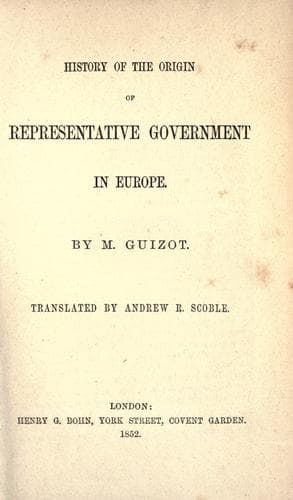
History of the Origin of Representative Government in EuropeGuizot, François
History
History of the Origin of Representative Government in Europe
Guizot, François
Europe -- History; Representative government and representation
IV. We find also, during the whole of this epoch, that benefices
were given or held hereditarily. In 587, it was stipulated by the
treaty of Andely, with regard to the concessions made by queen
Clotilda, that they should be perpetual. The law of the Visigoths
(of Chindasuinth, about 540) provides that the concessions made
by the princes should not be revoked. Marculf gives the formulary
for a hereditary concession. In 765, Charlemagne gave to an
individual named Jean, who had conquered the Saracens in the
province of Barcelona, a domain (says Fontaines) situated near
Narbonne; "in order that he and his posterity may possess it
without any fee or trouble, so long as they remain faithful to us
or to our children." The same Jean presented himself to Louis the
Debonnair, with the gift of Charlemagne, and demanded his
confirmation of it. Louis confirmed it, and added to it new
lands. In 884, Jean being dead, his son Teutfred presented
himself to Charles the Bald with the two donations just
mentioned, and asked him to confirm them to him. The king granted
this, as it is expressed, "in order that thou mayest possess
them, thou and thy posterity, without any fee." These successive
demands of confirmation, either at the death of the original
bestower, or at that of the original incumbent, prove that the
hereditary character of benefices was not then considered as a
right, even when it had been promised, and consequently that it
rested on no general law that was recognized by the state.
{120}
Tenure Of Benefices.
Public-domain text, read in full here on John Shaqi.
Reviews
Reviews
No reviews yet
Be the first to share your thoughts on this work.
Elsewhere in the archive
Join the Discussion
Join the discussion
Sign in to leave a comment or review.
Sign InorCreate an account