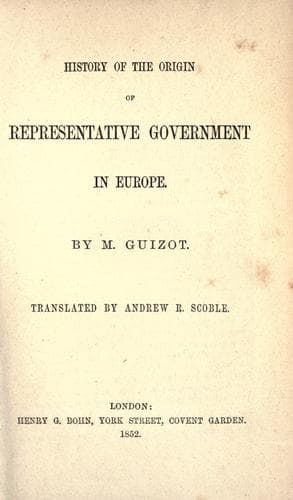
History of the Origin of Representative Government in EuropeGuizot, François
History
History of the Origin of Representative Government in Europe
Guizot, François
Europe -- History; Representative government and representation
Loyalty was at first due only to that chief to whom it had been
expressly promised, and from whom a benefice had been received.
Charlemagne attempted to change this into an obligation common to
all the freemen in his States. Marculf has preserved to us the
formula in which he wrote to his counts, requiring from all
individuals the oath of fidelity. Thus did this prince endeavour
to break through the feudal hierarchy which was consolidating
itself, to bring himself into a direct relation with all freemen,
and to make the relation between king and subject predominant
over that between lord and vassal. The oath of fidelity was
universally exacted by the successors of Charlemagne, Louis the
Debonnair and Charles the Bald, but without any effective
results; for the tendency to hierarchical and feudal aristocracy
had become prevalent. We find besides numerous examples of the
maintenance of the relations between incumbent and patron, even
under Charlemagne. Under Charles the Bald this relation became
more positive and independent of the king. The prince even, for
the repression of public crimes, allowed his authority to be
exercised through the intervention of the lord; he made each lord
responsible for the crimes of his own dependents. It was
therefore especially in the empire of the lord over his men, that
the means were then sought of sustaining order and repressing
crime. This alone will sufficiently indicate the continually
growing force of feudal relations and the diminishing authority
of royalty.
{124}
Lecture XV.
Of benefices conceded by great landowners to men dependent
upon them:
_First_, benefices conceded for all kinds of services,
and as a mode of paying salary;
_Secondly_, larger proprietors usurp the lands adjoining
their own, and bestow them as benefices on their
subordinates;
_Thirdly_, the conversion of a great number of allodial
lands into benefices, by the practice of
_recommendation_.
Origin and meaning of this practice.
Permanence of freeholds, especially in certain parts of the
Frankish monarchy.
Tributary lands.
Their origin and nature.
Their rapid extension: its causes.
General view of the condition of territorial
property, from the sixth to the eleventh century:
_First_, different conditions of territorial property;
_Secondly_, the individual dependence of territorial
property;
_Thirdly_, the stationary condition of territorial
wealth.
Why the system of beneficiary property, that is to say, the
feudal system, was necessary to the formation of modern society
and of powerful states.
Donors Of Benefices.
Public-domain text, read in full here on John Shaqi.
Reviews
Reviews
No reviews yet
Be the first to share your thoughts on this work.
Elsewhere in the archive
Join the Discussion
Join the discussion
Sign in to leave a comment or review.
Sign InorCreate an account