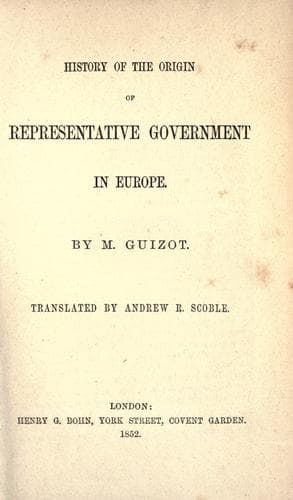
History of the Origin of Representative Government in EuropeGuizot, François
History
History of the Origin of Representative Government in Europe
Guizot, François
Europe -- History; Representative government and representation
III. A large number of allods were converted into benefices by
means of a tolerably ancient usage. Marculf has left us the
formula by which this conversion was made; its origin we must
seek in the practice of _recommendation_. Recommendation was
not primitively anything else than the choice of a chief, or a
patron. A law of the Visigoths, called a _lex antiqua_, and
which must be referred to king Euric, towards the close of the
fifth century, says: "If any one have given arms, or any other
thing, to a man whom he has taken under his patronage, these
gifts shall remain the property of him by whom they have been
received. If this latter choose another patron, he shall be free
to _recommend_ himself to whomsoever he will: this may not
be forbidden to a free man, for he belongeth to himself; but he
shall, in this case, return to the patron from whom he separates
himself all that he has received from him."
{126}
These were, then, the ancient Germanic customs. The relation of
the individual _recommended_ to his patron was a purely
personal one. The presents consisted in arms; his liberty
remained unimpaired. The law of the Lombards left to every one
the same liberty as the law of the Visigoths. Nevertheless, we
see, by the same capitulary, that this liberty began to be
restrained. Charlemagne defined the reasons by which any one
might be allowed to quit his lord, when he had received anything
from him. We may learn from this, that the ties contracted by
recommendation began to be strengthened. This practice became
very frequent. By these means order was promoted, so far as the
law was concerned, and protection and safety as far as concerned
the person recommended. When relations of service and protection
bearing a purely personal character were thus established with a
patron, other more tangible relations arose in which the property
of the parties was considered. The person recommended received
benefices from the lord, and became a vassal of his estate; or
rather he recommended his lands, as he had previously recommended
his person. _Recommendation_ thus became a part of the
feudal system, and it contributed most importantly to the
conversion of allodial estates into benefices.
Public-domain text, read in full here on John Shaqi.
Reviews
Reviews
No reviews yet
Be the first to share your thoughts on this work.
Elsewhere in the archive
Join the Discussion
Join the discussion
Sign in to leave a comment or review.
Sign InorCreate an account