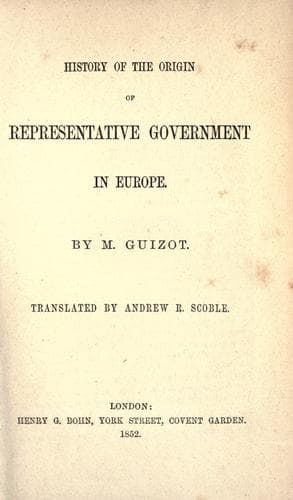
History of the Origin of Representative Government in EuropeGuizot, François
History
History of the Origin of Representative Government in Europe
Guizot, François
Europe -- History; Representative government and representation
_Secondly_, conquest was not the work of a single day; it
continued to be carried on after the establishment of the
invaders. All the documents of the period indicate that the
principal officers and large proprietors continually exerted
themselves, either to usurp the possessions of their less
powerful neighbours, or to impose upon them rentals or other
charges. These usurpations are proved by the multitude of laws
that were enacted to prevent it. In the unsettled state of
society that then existed, the feeble were entirely placed at the
disposal of the strong; public authority had become incompetent
for their protection; many lands which were at first free, and
belonged either to their ancient owners, or to Barbarians of
slender resources, fell into a tributary state; many of the
smaller proprietors purchased for themselves the protection of
the strong, by voluntarily placing their lands in this condition.
The most common method of rendering lands tributary, was to give
them either to churches or to powerful proprietors, and then to
receive them again, on the tenure of usufruct, to be enjoyed
during life, on the payment of fixed fees. This kind of contract
is to be met with again and again, during this period. The same
causes which tended to destroy allods, or to convert them into
benefices, acted with even more energy in augmenting the number
of tributary lands.
{128}
_Thirdly_, many large proprietors, whether of allodial lands
or of benefices, were unable themselves to cultivate the whole of
their lands, and gave them up by small portions to simple
cultivators, on the payment of certain fees and services. This
alienation took place under a multitude of forms and a variety of
circumstances; it certainly occasioned many lands to become
tributary. The large number and endless variety of rentals and
rights, known in a later time by the name of _feudal_, arose
probably either from similar contracts, or from usurpations
committed by the powerful proprietors. The constant recurrence in
writers and laws of the period of the terms _census_ and
_tributum_; the multitude of arrangements which relate to
them; the general course of events; lastly, the state in which
most landed property was found when order began to reappear,--all
these circumstances render it probable that at the end of the
period we are considering, the greater number of lands had fallen
into a tributary condition. Property and liberty were alike
devoted to be plundered. Individuals were so isolated, and their
forces so unequal, that nothing could prevent the results of such
a position.
Waste Lands.
Public-domain text, read in full here on John Shaqi.
Reviews
Reviews
No reviews yet
Be the first to share your thoughts on this work.
Elsewhere in the archive
Join the Discussion
Join the discussion
Sign in to leave a comment or review.
Sign InorCreate an account