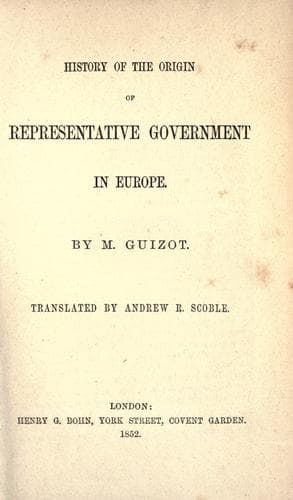
History of the Origin of Representative Government in EuropeGuizot, François
History
History of the Origin of Representative Government in Europe
Guizot, François
Europe -- History; Representative government and representation
I. There was a great diversity in the conditions of property. In
our days, the condition of property is uniform and everywhere the
same; whoever the proprietor may be, he possesses his property,
whatever may be its character, on the same tenure of right, and
subject to the same laws as any other. Between properties which
are the most distinct in character, there is thus far an
identity. This is one of the most unequivocal symptoms and safest
guarantees of the progress of legal equality. During the times of
which we have been speaking, the diversified conditions under
which property was held would necessarily lead to the formation
of several classes in society, between which existed great,
factitious, and permanent inequality. Men were not merely
proprietors to a greater or less extent; besides the inequality
in the amount of wealth, there was also an inequality in the
nature of the wealth possessed, than which it is impossible to
conceive of a more powerful instrument for oppression. Even this,
however, was a step in advance out of the slavery existing among
the ancients. The slave could possess nothing,--was essentially
incapable of owning property. In the times of which I am
speaking, the mass of the population had not become full and
absolute possessors of property, but was attaining to a
possession that was more or less imperfect and precarious, by
which it had gained the means of yet loftier ascents.
Isolation Of Proprietors.
II. Landed property was then submitted to the restraints of
dependence on individuals. At present, all property is free, and
is at the disposal only of its owner. General society has been
formed,--the State has been organized,--every proprietor is
united to his fellow-citizens by a multitude of ties and
relations, and to the state by the protection which he receives
from it, and the taxes to which he is subject in return: there
is, thus, independence without isolation.
{130}
From the sixth to the eleventh century, independence was
necessarily accompanied by isolation: the proprietor of an allod
lived upon his lands almost without buying or selling anything.
He owed scarcely anything to a State which hardly existed, and
which could not assure him of an efficient protection. The
condition, therefore, of the allods and their proprietors was at
that time a con that was to a considerable extent anti-social. In
more ancient times, in the forests of Germany, men without landed
properties lived at least in common. When they became
proprietors, if the allodial system had succeeded in becoming
prevalent, the chiefs and their associates would have been
separated, without ever being summoned to meet and recognize one
another as citizens. Society would not have been at all
constituted. It exists in those relations which unite men
together, and in the ties out of which these relations arise. It
necessarily demands a law, a condition of dependence. And when it
Public-domain text, read in full here on John Shaqi.
Reviews
Reviews
No reviews yet
Be the first to share your thoughts on this work.
Elsewhere in the archive
Join the Discussion
Join the discussion
Sign in to leave a comment or review.
Sign InorCreate an account