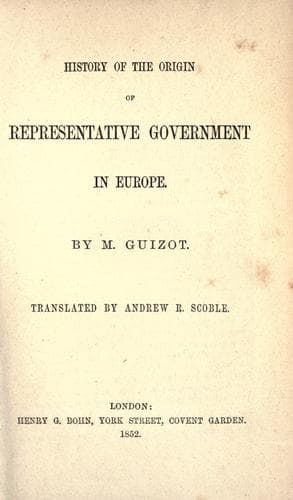
History of the Origin of Representative Government in EuropeGuizot, François
History
History of the Origin of Representative Government in Europe
Guizot, François
Europe -- History; Representative government and representation
We see by this table, that, notwithstanding the common opinion to
the contrary, the _wehrgeld_ is by no means an exact and
certain indication of social conditions. It is not determined
uniformly according to the origin, the quality, the position of
individuals. The circumstances of the murder, the official
character of the criminal, the greater or less usefulness or
commonness of the man slain, all these variable elements enter
into the determination of the _wehrgeld_. The simple fact of
the murder having been committed at the court of the duke, while
the victim is going to or returning from the house of the count,
triples the _wehrgeld_ of every man, whether he be a slave
or a freeman, a Barbarian or a Roman. The elements of the
_wehrgeld_ are very numerous; it varies according to places
and times. The Roman, the tributary, the slave, according to
circumstances, may be valued at a greater or a less sum than a
barbarian free man. We see many general indications which serve
to show that the Roman was commonly less esteemed than a
barbarian, the tributary or the slave less than the free man.
This is very easily accounted for, and might have been
anticipated. But it is not on this account less difficult to draw
from such facts a positive indication of the state of
individuals,--a precise and complete classification of social
conditions.
True Test Of Social Conditions.
There is no resource left but to renounce the idea of classifying
social conditions, and of determining the condition of persons,
according to any general principle, resting either on the nature
of territorial properties, or in the legal appreciation of the
value of different lives. We must simply inquire, by the aid of
historical facts, who were the strong and powerful at the time;
what common name was given to them; what share of influence and
of liberty fell to the lot of those who were simply called free
men.
{140}
We shall thus arrive at clearer and more certain results. We
shall often find that landed property is a great and principal
source of strength, and that the _wehrgeld_ is an indication
of the amount of importance or of liberty possessed by
individuals; but we shall not attribute to these two principles a
general and decisive authority, and we shall not mutilate facts
in order that they may harmonize with our hypotheses.
{141}
Lecture XVII.
Of the _Leudes_ or _Antrustions_.
Men, faithful to the king and to the large proprietors.
Different means of acquiring and retaining them.
Obligations of the _Leudes_.
The _Leudes_ are the origin of the nobility.
Bishops and heads of monasteries were reckoned among the
_leudes_ of the king.
Moral and material power of the bishops.
Efforts of the kings to possess themselves of the right of
nominating bishops.
Free men.
Did they form a distinct and numerous class?
The _arimanni_, and _rathimburgi_.
Mistake of M. de Savigny.
Public-domain text, read in full here on John Shaqi.
Reviews
Reviews
No reviews yet
Be the first to share your thoughts on this work.
Elsewhere in the archive
Join the Discussion
Join the discussion
Sign in to leave a comment or review.
Sign InorCreate an account