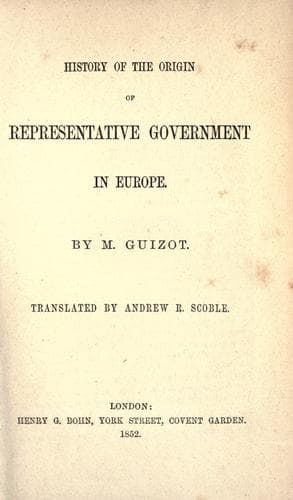
History of the Origin of Representative Government in EuropeGuizot, François
History
History of the Origin of Representative Government in Europe
Guizot, François
Europe -- History; Representative government and representation
5th. The number of Leudes was the principal source of strength;
accordingly they were multiplied by all kinds of devices. In 587,
in the treaty of Andely, between Gontran and Childebert II, "it
was agreed that neither of them should attempt to draw over to
himself the Leudes of the other, or receive them if they came of
their own accord." We continually find Leudes of importance
threatening the king to leave his service, and enter into some
other.
The general obligation of the Leudes was fidelity, service in the
palace, and military service. The price of this obligation was,
for the Leudes, power and riches. They had also certain civil
advantages, but of a more uncertain nature. Their _wehrgeld_
was a larger amount, whatever might otherwise have been their
origin. We see that their prerogatives accumulated in proportion
as their power was consolidated by the long possession of
benefices. Charlemagne desired that his vassals should be
honoured, and should hold, after himself, the first place in
esteem. There were however among the Leudes of the king some who
were less powerful, and some who even were poor.
Every large proprietor had his Leudes; his house was organized
after the model of the king's; the same offices existed in each.
It is the opinion of Montesquieu, who is in this opposed by
Montlosier, that the origin of the nobility is to be found in the
Leudes. Neither of them has formed, in my judgment, a just and
clear idea either of the condition of the Leudes or of the
character of the nobility. The rank of the Leude and his
advantages were purely of a personal character.
{143}
The rank of a free Barbarian was hereditary, as were also his
advantages: but the rank of the Leude, that is to say, the
advantages and the superiority which he derived from his
position, tended to become hereditary; that of the free man, on
the other hand, tended, when he was isolated and left to himself,
to become effaced and to lose its advantages. Most free men who
did not become beneficiaries, vassals, Leudes of some importance,
ceased to be free at all. The aristocracy of the Leudes tended to
be constituted, the liberty of the free men tended to be
destroyed:--the free men were, viewed in contrast with those who
were not free, an aristocracy on the decline; the Leudes were,
compared with free men, an aristocracy on the increase.
Formation Of The Frankish Nobility.
Public-domain text, read in full here on John Shaqi.
Reviews
Reviews
No reviews yet
Be the first to share your thoughts on this work.
Elsewhere in the archive
Join the Discussion
Join the discussion
Sign in to leave a comment or review.
Sign InorCreate an account