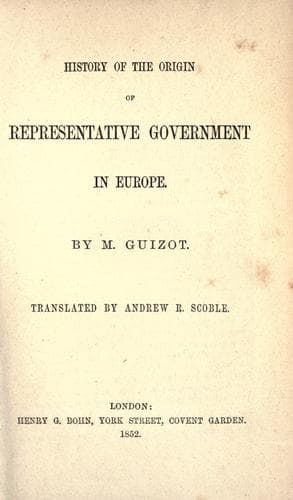
History of the Origin of Representative Government in EuropeGuizot, François
History
History of the Origin of Representative Government in Europe
Guizot, François
Europe -- History; Representative government and representation
Free Men.
From the Leudes, let us pass to those who were simply free men.
There are words which have, in our time, so simple and absolute a
signification, that we apply them without consideration or
scruple to times in which their actual significance was not
recognized at all. The expression _free man_ is an example.
If by it we mean the man who is not a slave, the man who is not
the property of another man, and can neither be given nor sold as
an article of traffic, there were a great number of free men from
the fifth to the tenth centuries. But if we attach to this
expression the political sense which it possesses in our days,
that is to say, the idea of a citizen dependent on no other
citizen, who depends for the safety of his person and his
property only upon the state, and the laws of the state, the
number of free men was very inconsiderable at the period of which
we speak, and was continually diminishing. Most of those who were
not serfs were engaged or were binding themselves with increasing
frequency, either for the security of their persons or of their
properties, to the service, and to a certain amount of dependency
upon some man more powerful than themselves, who employed them in
his house or protected them at a distance. The independence of
the citizen as it existed in the republics of antiquity, and as
it exists in our public communities, became more and more rare
from the fifth to the tenth centuries. Eminent publicists, M. de
Savigny among others, in his _Histoire du droit romain dans le
moyen âge_, have affirmed that always at this period a
numerous class of free men existed, true citizens, exempt from
all personal dependence, depending only upon the state and
forming the body of the nation.
{146}
This involves a complete confusion of times' and a
misapprehension of the natural succession of events. Doubtless at
the time of the invasion, and during the period which immediately
followed it, there were many free men of this kind; the
independence of individuals who live a wandering and barbarian
life did not suddenly and completely vanish under the influence
of the new circumstances which resulted from their territorial
establishment. But, so far as regards the greater number of free
men, this independence was rapidly absorbed by new ties, and by
the very numerous and various forms of feudal hierarchy. We may
think we have found, under certain names which are frequently to
be met with in documents and historical works, such as,
_Arimanni, Erimanni, Herimanni, Hermanni_, among the
Lombards, and _Rachimburgi, Rathimburgi, Regimburgi_, among
the Franks, a class of men actually free--citizens in the sense
in which we use the words at the present time. But when we
investigate more closely, we soon learn that no such class is to
be found, and that nearly if not quite all the _Arimanni_ or
_Rathimburgi_, were bound in the fetters of a feudal
organization and depended far more on some superior individual
Public-domain text, read in full here on John Shaqi.
Reviews
Reviews
No reviews yet
Be the first to share your thoughts on this work.
Elsewhere in the archive
Join the Discussion
Join the discussion
Sign in to leave a comment or review.
Sign InorCreate an account