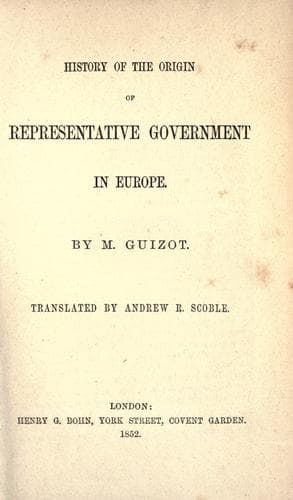
History of the Origin of Representative Government in EuropeGuizot, François
History
History of the Origin of Representative Government in Europe
Guizot, François
Europe -- History; Representative government and representation
The system of free institutions rapidly declined. It succumbed
beneath the system of the predominance of the great landowners,
and of the hierarchy of benefices. A conflict arose between the
principles of the feudal system, and the endeavours of the
monarchical system. In the conflict of these two systems,
however, we find remnants of the system of free institutions.
These remnants were allied sometimes to the feudal, sometimes to
the monarchical system--most frequently to the latter.
Charlemagne attempted to render the institutions of liberty
auxiliary to the triumph of the monarchical system. We observed
something analogous to this in the history of the Anglo-Saxons;
but there the system of free institutions never perished; the
common deliberation of the free landowners, in the county-courts,
always subsisted. Among the Franks, the simultaneity and conflict
of the three systems were more distinct and animated; the first
was the weakest and perished early.
{150}
In treating of the Franks, as of the Anglo-Saxons, we shall first
examine their local institutions, and then their general
institutions; and we shall everywhere meet with the great fact to
which I have just alluded. We shall follow it in its
vicissitudes, and we shall see, first, how the system of free
institutions perished, in localities and at the centre; secondly,
how the monarchical system was for a moment really successful and
strongly predominant under Charlemagne alone; and thirdly, how
the feudal system, that is to say, the aristocratic and
hierarchical organization of territorial properties and
sovereignties, could not but prevail, as it really did in the
end.
Of Local Institutions.
In Frankish Gaul, as among the Anglo-Saxons, the territory was
divided into counties, hundreds, and tythings. [Footnote 14]
[Footnote 14: That is, of course, districts analogous to
these divisions.]
The counts were called _grafen, judices;_ the centeniers,
_centgrafen;_ and the tything-men, _tungini,
thingrafen._ Each of these officers held a court, _placitum,
mallum,_ at which justice was administered, and the business
of the district transacted. This court was at first an assembly
of all the free men of the district; they were bound to attend,
and a heavy fine was imposed as the penalty for non-attendance.
There, as I have said, they distributed justice, and deliberated
upon matters of common interest. Civil transactions, sales,
wills, enfranchisements, were carried on in public. There, also,
military convocations were made. The court or _plaid_ of the
tything-man, _decanus_, is seldom met with, and was of
little importance, as in England. The powers of the courts or
assemblies of free men, held by the _centenarii_ and
_vicarii_ were somewhat limited; judgments could not be
given upon questions involving property or personal liberty,
unless it were in presence of the imperial envoys or the counts.
Public-domain text, read in full here on John Shaqi.
Reviews
Reviews
No reviews yet
Be the first to share your thoughts on this work.
Elsewhere in the archive
Join the Discussion
Join the discussion
Sign in to leave a comment or review.
Sign InorCreate an account