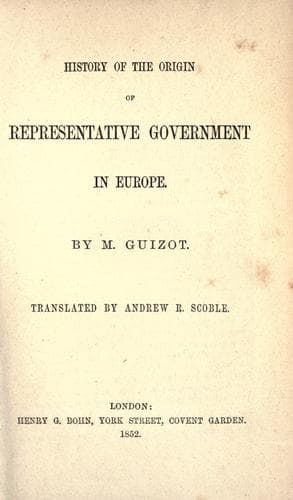
History of the Origin of Representative Government in EuropeGuizot, François
History
History of the Origin of Representative Government in Europe
Guizot, François
Europe -- History; Representative government and representation
Such were, during the period of twelve centuries which elapsed
between the treaty of Rome with Cœre and the reign of Leo the
Philosopher, the great revolutions of the municipal system in the
Roman world. We may characterize them by saying that, during the
first period, the municipal system was a liberty granted, in
fact, to the inhabitants of the towns; during the second, it was
a right legally constituted, as an indemnity for the loss of
political privileges; and, during the third, it was a burden
imposed upon a certain class of citizens.
I now terminate its history. In our next lecture, we shall
investigate the real state of the municipal system during the
third period, and its influence upon the condition of the
citizens.
{193}
Lecture XXIII.
Of the various social conditions in the Roman Empire, before
the final invasion of the Barbarians.
The privileged classes, and curials.
Their obligations, functions, and immunities.
Attributes of the _curia_ as a body.
Of the various municipal magistracies and offices.
Of the _Defender_ in cities.
Comparison of the development of the municipal system, and its
relations to the central organization of the State in the Roman
Empire and in modern societies.
Social Conditions In The Roman Empire
At the commencement of the fifth century the subjects of the
Empire were divided into three classes, forming three very
distinct social conditions:
1. The privileged classes;
2. The curials;
3. The common people. I speak only of free men.
The privileged class included:
1. The members of the Senate, and all those who were entitled
to bear the name of _clarissimi;_
2. The officers of the palace;
3. The clergy;
4. The cohortal militia, a sort of _gendarmerie_ employed
in the maintenance of the internal order of the State, and the
execution of the laws;
5. The soldiers in general, whether included in the legions, or
in the troops attached to the palace, or in the corps of
barbarian auxiliaries.
The class of curials comprehended all the citizens inhabiting
towns, whether natives or settlers therein, who possessed a
certain landed income, and did not belong, by any title, to the
privileged class. The common people were the mass of the
inhabitants of the towns, whose almost absolute want of property
excluded them from a place among the curials.
The privileged members of the first class were numerous, of
various rank, and unequally distributed among the five orders of
which it was composed; but that which was, in fact, the most
important and most sought after of their privileges, that which
alone was more valuable than all the rest, was common to the five
orders which constituted this class--I mean, exemption from
municipal functions and offices.
{194}
When we come to treat of the curials, you will learn what was the
extent of these duties; but you must first understand clearly who
were exempt from them.
Public-domain text, read in full here on John Shaqi.
Reviews
Reviews
No reviews yet
Be the first to share your thoughts on this work.
Elsewhere in the archive
Join the Discussion
Join the discussion
Sign in to leave a comment or review.
Sign InorCreate an account